A
A-Values
Definition: Quantitative measure of axial vs equatorial preference in cyclohexanes.
Context: Predicts conformational populations and stereochemical outcomes.
Example: t-Bu substituent has large A-value.
Related Terms: Conformation, 1,3-Diaxial Interactions.
Reference: Eliel & Wilen (1994).
Absolute Configuration

Associated Concept:
Relative Configuration
Definition: The unambiguous three-dimensional spatial arrangement of substituents around a stereogenic element, defined independently of any other stereocenter and commonly designated using the Cahn-Ingold-Prelog (CIP) system (R/S, E/Z, P/M).
Context: Absolute configuration provides the definitive stereochemical identity of a molecule. In pharmaceutical chemistry, it is a regulatory requirement to specify absolute configuration for chiral active pharmaceutical ingredients, as different configurations can lead to distinct pharmacological, toxicological, and metabolic outcomes. Absolute configuration must be established using reliable methods such as X-ray crystallography (with anomalous dispersion), vibrational circular dichroism, electronic circular dichroism with exciton analysis, or unambiguous chemical correlation.
Example: The assignment of (S)-thalidomide and (R)-thalidomide, where each enantiomer exhibits markedly different biological effects.
Related Terms: Relative Configuration; CIP Rules; Stereogenic Center; Absolute Stereochemistry; Misassignment of Configuration.
Reference: IUPAC. Compendium of Chemical Terminology (IUPAC Gold Book). 2nd Edition, 1997 (updated 2019).
Achiral
Associated Concept:
Chiral
Definition: A molecule or object that is superimposable on its mirror image.
Context: Achirality implies the absence of optical activity and stereochemical differentiation. Such molecules do not exhibit enantiomeric forms.
Example: Methane, Dichloromethane (lack stereogenic center), Meso-tartaric acid is achiral despite having two stereocenters.
Related Terms: Chiral; Symmetry; Plane of symmetry; Meso-compound.
Reference: IUPAC. Compendium of Chemical Terminology (IUPAC Gold Book), 2nd Edition, 1997 (updated 2019).
Activity Cliff

Broader Concept:
Structure-Activity Relationship (SAR)

Narrower Concept:
Chirality Cliff
Associated Concept:
QSAR
Definition: A phenomenon in which two structurally similar molecules exhibit a disproportionately large difference in biological activity, potency, or other relevant biological properties. Activity cliffs highlight abrupt changes in the structure-activity relationship (SAR) and are valuable for understanding molecular determinants of biological function.
Synonyms: SAR Cliff; Structure-Activity Cliff (less common).
Context: Activity cliffs are fundamental concepts in medicinal chemistry, cheminformatics, and drug discovery. They identify pairs or groups of compounds that are highly similar in chemical structure but differ markedly in biological activity. Studying activity cliffs helps medicinal chemists identify structural features critical for target binding, optimize lead compounds, improve QSAR models, and guide rational drug design. Chirality cliffs represent a special class of activity cliffs in which the dramatic activity difference arises solely from stereochemistry.
Example: Two analogues differing only by replacement of a methyl group with an ethyl group may exhibit a 100-fold difference in enzyme inhibitory activity, constituting an activity cliff. Similarly, when the only structural difference is stereochemistry, the phenomenon is referred to as a chirality cliff.
Related Terms: Structure-Activity Relationship (SAR), Chirality Cliff, Bioisostere, Molecular Similarity, QSAR, Lead Optimization, Scaffold Hopping.
Reference: Stumpfe, D., Hu, Y., & Bajorath, J. (2014). "Evolving Concept of Activity Cliffs." ACS Omega, 1, 143-150.
Additional References: Maggiora, G. M. (2006). "On Outliers and Activity Cliffs-Why QSAR Often Disappoints." Journal of Chemical Information and Modeling, 46, 1535.
Bajorath, J. (2019). "Activity Cliffs: A Valuable Concept in Medicinal Chemistry." Future Medicinal Chemistry, 11, 2081-2084.
International Union of Pure and Applied Chemistry. Compendium of Chemical Terminology (Gold Book) - Entries related to structure-activity relationships (although "activity cliff" itself is not an official IUPAC-defined term).
Key Distinction
Activity Cliff: A small structural modification leads to a large change in biological activity.
Chirality Cliff: A special type of activity cliff in which stereochemistry alone is responsible for the dramatic change.
Structure-Activity Relationship (SAR): Describes the general relationship between molecular structure and biological activity.
QSAR: Uses mathematical and computational models to quantitatively predict SAR.
Key Insight
An activity cliff represents a discontinuity in the structure-activity relationship: compounds that appear highly similar structurally may behave very differently biologically. These "cliffs" often reveal the molecular features most critical for target recognition and are therefore invaluable for lead optimization, drug design, and machine learning models. Among activity cliffs, chirality cliffs are particularly important because a change in stereochemistry alone can produce profound differences in efficacy, selectivity, pharmacokinetics, or toxicity.
Allenes
Definition: Cumulenes (C=C=C) that can be chiral due to orthogonal π systems.
Context: Provide axial chirality in drug scaffolds and ligands.
Example: Chiral 1,3-disubstituted allenes.
Related Terms: Axial Chirality, Atropisomerism.
Reference: Eliel & Wilen (1994).
Allylic Strain (A¹,³)
Definition: Steric/electronic repulsion across allylic systems affecting conformation and selectivity.
Context: Explains axial selectivity and diastereocontrol.
Example: Asymmetric allylation reactions.
Related Terms: A-Values, Stereoelectronic Effects.
Reference: Hoffmann, Acc. Chem. Res. (1971).
Analytical Method Validation (Chiral)
Definition: Validation of chiral analytical procedures for specificity, accuracy, precision, and robustness.
Context: Required for release and stability testing of chiral APIs.
Example: Validation of chiral HPLC method for enantiomeric purity.
Related Terms: ICH Q2(R2), Chiral HPLC.
Reference: ICH Q2(R2) (2022).
Anisotropy Factor (g)
Definition: CD intensity normalized to absorbance (Δε/ε).
Context: Enables quantitative comparison of chiroptical responses; important in CPL materials.
Example: g ~ 10-3; for many organic chromophores.
Related Terms: CD, CPL.
Reference: Barron (2004).
Anomer
Broader Concept:
Epimer
Definition: A subtype of epimer differing at the anomeric carbon in cyclic sugars.
Context: Critical in carbohydrate chemistry, anomeric configuration influences stability, solubility, and biological recognition.
Example: α-D-glucose vs β-D-glucose.
Related Terms: Epimer, Anomeric Effect, Carbohydrate Stereochemistry.
Reference: IUPAC Gold Book.
Anomeric Effect
Definition: Preference for axial orientation of electronegative substituents at the anomeric center in pyranoses.
Context: Influences glycoside stability and reactivity in medicinal chemistry.
Example: Axial methoxy in methoxytetrahydropyran.
Related Terms: Stereoelectronic Effect, Carbohydrate Stereochemistry.
Reference: Deslongchamps (1983).
Anti-(Stereochemical Descriptor)
Associated Concept:
Syn (Stereochemical Descriptor)
Definition: Describes two substituents or groups positioned on opposite sides of a reference plane or dihedral angle (180° apart).
Context: Used to describe relative configuration in alkenes, aldols, and conformational analysis.
Example: Anti-periplanar geometry in E2 eliminations or anti-diol configurations.
Related Terms: Syn; Antiperiplanar; Synclinal.
Reference: IUPAC. Compendium of Chemical Terminology (IUPAC Gold Book), 2nd Edition, 1997 (updated 2019).
Asymmetric Amplification
Definition: Small initial enantiomeric bias is amplified during reaction or crystallization.
Context: Useful in chiral self-replication and deracemization protocols.
Example: Soai reaction ee amplification.
Related Terms: Absolute Asymmetric Synthesis.
Reference: Soai, Nature (1995); Blackmond, PNAS (2004).
Asymmetric Catalysis
Definition: Catalysis that yields one enantiomer preferentially.
Context: Cornerstone of modern manufacturing of single-enantiomer drugs.
Example: Noyori asymmetric hydrogenation.
Related Terms: Organocatalysis, Biocatalysis.
Reference: Noyori, Nobel Lecture (2001).
Asymmetric Synthesis (Chiral Synthesis)
Broader Concept:
Stereoselective Synthesis
Associated Concept:
Chiral Separation
Definition: A chemical synthesis that preferentially forms one enantiomer or diastereomer over the other, resulting in an enantioenriched or enantiopure product through the use of a chiral source such as a chiral catalyst, chiral reagent, chiral auxiliary, enzyme, or substrate.
Context: Asymmetric synthesis is one of the principal strategies for producing optically active compounds without resolving a racemate. It is widely employed in the pharmaceutical, agrochemical, and fine chemical industries to prepare single-enantiomer products with high enantiomeric excess (ee). Advances in asymmetric catalysis, organocatalysis, biocatalysis, and transition-metal catalysis have made asymmetric synthesis an indispensable tool in modern drug discovery and manufacturing.
Example: The asymmetric hydrogenation of prochiral alkenes using the chiral BINAP-ruthenium catalyst, developed by Ryoji Noyori, produces enantiomerically enriched products and has been widely applied in the industrial synthesis of pharmaceuticals.
Related Terms: Asymmetric Catalysis, Chiral Catalyst, Chiral Auxiliary, Chiral Reagent, Enantioselective Synthesis, Stereoselective Synthesis, Chiral Resolution, Kinetic Resolution.
Reference: Noyori, R. (1994). Asymmetric Catalysis in Organic Synthesis. John Wiley & Sons, New York. ISBN: 978-0471351970; Ojima, I. (Ed.). (2013). Catalytic Asymmetric Synthesis (3rd ed.). John Wiley & Sons. ISBN: 978-1118390055; Walsh, P. J., & Kozlowski, M. C. (2009). Fundamentals of Asymmetric Catalysis. University Science Books. ISBN: 978-1891389543; Knowles, W. S. (2003). "Asymmetric Hydrogenations (Nobel Lecture)." Angewandte Chemie International Edition, 42, 2-9.
International Union of Pure and Applied Chemistry. Compendium of Chemical Terminology (Gold Book) - Entries on asymmetric synthesis and stereoselective synthesis.
Key Distinction
Asymmetric Synthesis (Chiral Synthesis): Produces one stereoisomer preferentially from achiral or prochiral starting materials using a chiral influence.
Stereoselective Synthesis: Preferentially forms one stereoisomer over another but may involve either enantiomers or diastereomers and does not necessarily require a chiral source.
Enantioselective Synthesis: A type of asymmetric synthesis that preferentially produces one enantiomer.
Chiral Resolution: Separates existing enantiomers from a racemate rather than creating chirality during synthesis.
Key Insight:
Asymmetric synthesis creates chirality during the synthetic process by favoring the formation of one stereoisomer. In contrast, chiral resolution separates stereoisomers that have already been formed. Asymmetric synthesis is generally more atom-efficient and can theoretically achieve 100% yield of the desired enantiomer, making it the preferred strategy for the industrial production of many modern single-enantiomer pharmaceuticals.
Asymmetric Transfer Hydrogenation (ATH)
Definition: Hydrogen transfer from donors (iPrOH, formate) to substrates using chiral catalysts.
Context: Avoids H2 gas; scalable and selective.
Example: Noyori–Ikariya systems reducing ketones.
Related Terms: Noyori Hydrogenation, Organocatalysis.
Reference: Ikariya & Noyori, Acc. Chem. Res. (2007).
Atropisomerism
Associated Concept:
Conformational Isomerism
Definition: Stereoisomerism due to hindered rotation that creates isolable enantiomers.
Context: Drug candidates may have atropisomeric axes requiring control and specification.
Example: Atropisomeric biaryl kinase inhibitors.
Related Terms: Axial Chirality, Barrier to Rotation.
Reference: Clayden et al. (2012).
Atropos Ligand
Associated Concept:
Tropos Ligand
Definition: A chiral ligand that possesses a configurationally stable stereogenic axis, such that its atropisomeric forms do not readily interconvert under normal reaction conditions. The ligand's axial chirality is effectively "locked," allowing the individual atropisomers to be isolated and used as distinct chiral entities.
Context: The term atropos (from the Greek Atropos, meaning "inflexible" or "unchangeable") describes atropisomeric ligands with sufficiently high rotational barriers around a bond-typically a biaryl axis-to prevent racemization at ambient temperatures. Atropos ligands play a central role in asymmetric catalysis because their well-defined and persistent chirality can be efficiently transferred to substrates, often resulting in high enantioselectivities. Many of the most successful chiral ligands used in industry belong to this category.
Example: BINAP is a classic atropos ligand. Its biaryl axis is configurationally stable, and the two atropisomers, (R)-BINAP and (S)-BINAP, can be isolated and used independently in asymmetric catalytic reactions.
Related Terms: Tropos Ligand, Atropisomerism, Axial Chirality, Chiral Ligand, Configurational Stability, Asymmetric Catalysis.
Reference: Noyori, R. (2002). Asymmetric Catalysis: Science and Opportunities (Nobel Lecture). Angewandte Chemie International Edition, 41, 2008-2022; Bringmann, G., Mortimer, A. J. P., Keller, P. A., Gresser, M. J., Garner, J., & Breuning, M. (2005). "Atroposelective Synthesis of Axially Chiral Biaryl Compounds." Angewandte Chemie International Edition, 44, 5384-5427; Noyori, R. (1994). Asymmetric Catalysis in Organic Synthesis. John Wiley & Sons. ISBN: 978-0471351970. International Union of Pure and Applied Chemistry. Compendium of Chemical Terminology (Gold Book) - Entries related to atropisomerism and axial chirality
Axial Bond
Definition: A bond directed along the axis of a cyclohexane chair, perpendicular to the mean plane.
Context: Axial substituents experience 1,3-diaxial interactions, strongly influencing conformation and reactivity.
Example: Axial vs equatorial methyl in methylcyclohexane.
Related Terms: Equatorial Bond, A-Values, Conformation.
Reference: Eliel & Wilen (1994).
Axial Chirality
Broader Concept:
Chirality Associated Concept:
Chiral Center Definition: Chirality arising from hindered rotation about an axis.
Context: Common in biaryls and allenes; impacts ligand and API design.
Example: BINAP, biaryl atropisomers.
Related Terms: Atropisomerism, Helicity.
Reference: IUPAC Gold Book.
B
Barrier to Rotation (ΔG‡)
Definition: Free-energy barrier that separates enantiomeric conformers/atropisomers.
Context: Determines isolability of atropisomers and labeling requirements.
Example: ΔG‡ > ~25 kcal/mol gives isolable atropisomers at room temperature.
Related Terms: Atropisomerism, Enantiomerization.
Reference: Eliel & Wilen (1994).
Bioactive Conformation
Definition: The conformation adopted by a ligand when bound to its target.
Context: Guides conformational constraint strategies to improve selectivity.
Example: Locked isostere mimicking bound pose.
Related Terms: Conformation, Pharmacophore.
Reference: Silverman (2014).
Bite Angle
Definition: Angle between donor atoms of a bidentate ligand at the metal center.
Context: Modulates enantioselectivity and reactivity in catalytic cycles.
Example: Wide-bite vs narrow-bite diphosphines.
Related Terms: Quadrant Model, Chiral Ligand.
Reference: van Leeuwen, Coordination Chemistry Reviews (1999).
Bürgi–Dunitz Angle
Definition: Preferred trajectory (~107°) of nucleophile approach to a carbonyl.
Context: Rationalizes facial selectivity and reaction rates.
Example: Hydride addition to ketones.
Related Terms: Felkin–Anh, Cram’s Rule.
Reference: Bürgi & Dunitz, JACS (1973).
C
CBS Reduction
Definition: Corey–Bakshi–Shibata borane reduction of ketones using chiral oxazaborolidines.
Context: Reliable route to enantioenriched alcohols.
Example: CBS reduction of aryl ketones.
Related Terms: Asymmetric Catalysis, Reduction.
Reference: Corey, JACS (1987).
Chelation Control
Definition: Metal coordination overrides Felkin preferences in carbonyl additions.
Context: Explains opposite selectivity in presence of Lewis acids or metals.
Example: Addition to α-alkoxy aldehydes with Mg2+.
Related Terms: Cram’s Rule, Felkin–Anh.
Reference: Reetz, Angew. Chem. (1974).
Chiral
Associated Concept:
Achiral
Definition: A geometric property of a molecule or object that is not superimposable on its mirror image.
Context: Chirality is foundational in stereochemistry, determining whether enantiomers exist and influencing pharmacological activity.
Example: Hands are chiral objects; lactic acid has R- and S-enantiomers.
Related Terms: Enantiomer; Chiral Center; Stereoisomer.
Reference: IUPAC. Compendium of Chemical Terminology (IUPAC Gold Book), 2nd Edition, 1997 (updated 2019).
Chiral Auxiliary
Definition: Temporarily attached chiral unit to control stereochemistry of a transformation.
Context: Delivers high selectivity; removed to give target enantioenriched product.
Example: Evans oxazolidinone auxiliaries.
Related Terms: Chiral Pool, Asymmetric Catalysis.
Reference: Evans, JACS (1981).
Chiral Awareness
Definition: The explicit recognition and incorporation of chirality in thinking, language, experimental design, data handling, modeling, regulation, and decision-making. Chiral awareness involves treating stereoisomers-especially enantiomers and diastereomers-as distinct chemical entities with potentially different properties, activities, safety profiles, and biological outcomes.
Example: Correct specification of stereochemical configuration in names, drawings, and databases; Clear communication of stereochemistry in teaching, papers, labels, and reports; Discrimination between stereoisomers in experiments, analysis, and modelling consideration of stereoselective pharmacology, metabolism, and toxicity; Avoidance of "stereochemical collapse" in AI/ML representations and informatics.
Related terms: Chiral-aware (adjectival form); Chiral Literacy; Chiral Intelligence; Chiral Bias; Stereo-blindness; Stereo-sloppy.
References: Eliel, E. L., & Wilen, S. H. Stereochemistry of organic compounds. New York: Wiley (1994);
Ariens, E. J. Stereochemistry, a basis for sophisticated nonsense in pharmacokinetics and clinical pharmacology. European Journal of Clinical Pharmacology, 26, 663-668 (1984);
Smith, S. W. Chiral toxicology: It's the same thing... only different. Toxicological Sciences, 110(1), 4-30 (2009).
Chiral Bioequivalence
Definition: Demonstration that enantiomer exposure (AUC, Cmax) is equivalent between products.
Context: Regulatory expectation for racemates and single-enantiomer generics.
Example: Bioequivalence of racemic vs reformulated enantiomer products.
Related Terms: Bioequivalence, FDA Chiral Policy.
Reference: FDA Guidance (2017); FDA 1992 Policy.
Chiral CE (Capillary Electrophoresis)
Definition: Electrophoretic separation with chiral selectors (e.g., cyclodextrins) in the buffer.
Context: High-efficiency analytical separations for enantiomers.
Example: CE of amino acid enantiomers.
Related Terms: Chiral HPLC, CSP.
Reference: Scriba, Electrophoresis (2003).
Chiral Center (Central Chirality)
Broader Concept:
Chirality
Associated Concept:
Axial ChiralityDefinition: A tetrahedral atom (usually carbon) bonded to four different substituents.
Context: Creates enantiomeric pairs; critical for drug selectivity and metabolism.
Example: The α-carbon of lactic acid.
Related Terms: Stereocenter, Enantiomer.
Reference: IUPAC Gold Book.
Chiral Chromatography
Broader Concept:
Chromatography
Associated Concept:
Chiral Stationary Phase (CSP)
Narrower Concepts:
Chiral HPLC |
Chiral SFC |
Chiral GC |
Chiral Capillary Electrophoresis
Definition:
Chiral chromatography is a chromatographic technique used to separate, identify, and quantify the individual enantiomers of chiral compounds. It exploits stereoselective interactions between the analyte and a chiral selector, typically incorporated into a chiral stationary phase (CSP) or, less commonly, a chiral mobile phase additive (CMPA), resulting in differential retention of enantiomers.
Context: Chiral chromatography is one of the most important analytical techniques in pharmaceutical research, drug development, quality control, and regulatory analysis. It enables the determination of enantiomeric purity, enantiomeric excess (ee), and stereochemical stability of chiral drugs and intermediates. Common chromatographic techniques include chiral HPLC, supercritical fluid chromatography (SFC), gas chromatography (GC), capillary electrophoresis (CE), and thin-layer chromatography (TLC) using chiral selectors. The choice of separation method depends on the physicochemical properties of the analyte, the chiral selector, and the analytical objective.
Example: The enantiomers of warfarin, ibuprofen, and propranolol can be resolved using polysaccharide-based chiral stationary phases in HPLC or SFC. Chiral chromatography is routinely employed to verify the enantiomeric purity of single-enantiomer pharmaceutical products and to monitor stereoselective synthesis.
Related Terms:
Chiral Separation, Chiral Stationary Phase (CSP), Chiral Selector, Chiral Mobile Phase Additive (CMPA), Enantiomeric Separation, Enantiomeric Excess (ee), Resolution (Rs), HPLC, SFC, Gas Chromatography, Capillary Electrophoresis.
Reference:
Aboul-Enein, H. Y., & Ali, I. (2003). Chiral Separations by Liquid Chromatography and Related Technologies. Marcel Dekker, New York.
Ahuja, S. (Ed.). (2000). Chiral Separations by Chromatography. Oxford University Press.
Allenmark, S. (Ed.). (1991). Chromatographic Enantioseparation: Methods and Applications. Ellis Horwood.
Francotte, E., & Lindner, W. (Eds.). (2006). Chirality in Drug Research. Wiley-VCH.
Gubitz, G., & Schmid, M. G. (2008). Chiral separation principles in capillary electrophoresis. Journal of Chromatography A, 1204(2), 140-156.
Okamoto, Y., & Yashima, E. (1998). Polysaccharide derivatives for chromatographic separation of enantiomers. Angewandte Chemie International Edition, 37(1-2), 102-119.
Subramanian, G. (Ed.). (2008). Chiral Separation Techniques: A Practical Approach (3rd ed.). Wiley-VCH.
Key Distinction (recommended for Chiralpedia)
Chiral chromatography is an analytical or preparative separation technique that resolves enantiomers based on differential interactions with a chiral environment. It differs from chiral resolution, which is the broader process of obtaining individual enantiomers and may involve chromatographic, crystallization, enzymatic, or chemical methods.
Key Insight
Chiral chromatography has become the gold standard for enantiomeric analysis in the pharmaceutical industry, providing highly sensitive and reliable methods for assessing stereochemical purity, supporting regulatory compliance, and enabling the development of safer, more effective chiral medicines.
Chiral Derivatizing Agent (CDA)
Definition: Enantiomers are converted to diastereomers by reacting with a chiral reagent to enable separation.
Context: Facilitates NMR/LC analysis when direct separation is difficult.
Example: Mosher’s acid chloride (MTPA-Cl).
Related Terms: CDA, Chiral Solvating Agent.
Reference: Mosher, JACS (1973).
Chiral Drug
Definition: A pharmaceutical compound that contains one or more chiral centers or stereogenic elements, existing as enantiomers, diastereomers, or mixtures.
Context: Regulatory and therapeutic implications are critical; one enantiomer may be active (eutomer) while the other may be inactive or harmful (distomer).
Example: Ibuprofen (sold as a racemate, though only the S-enantiomer is pharmacologically active).
Related Terms: Enantiopure; Racemate; Eutomer; Distomer; Stereo-pharmacology.
Reference: FDA. Policy Statement for the Development of New Stereoisomeric Drugs (1992).
Chiral Education
Definition: The structured teaching and learning of chirality and stereochemistry, from fundamental spatial concepts to advanced applications in synthesis, biology, and medicine.
Context: Chiral education spans undergraduate instruction, professional training, and continuing education. Modern chiral education emphasizes three-dimensional thinking, molecular visualization, biological relevance, and translational impact, particularly in medicinal chemistry and pharmaceutical sciences.
Example: Teaching stereochemistry using molecular models and real drug case studies (e.g., thalidomide, ibuprofen, citalopram) rather than only abstract projections.
Related Terms: Chiral Literacy; Stereochemistry; Medicinal Chemistry; Stereo-pharmacology, Chiral Pharmacology
Reference: Holme, T. A. Assessing conceptual understanding in stereochemistry. Journal of Chemical Education, 96, 401-410 (2019); Nicoll, G. Investigating student misconceptions in organic chemistry: Stereochemistry and representations. Journal of Chemical Education, 78, 623-627 (2001); Clement, J., & Ainsworth, S. Multiple visual representations in chemistry learning. Topics in Cognitive Science, 10, 857-874 (2018); Underwood, S. M., et al. Expert-novice differences in interpreting stereochemical representations. Journal of Chemical Education, 93, 2014-2021 (2016).
Chiral Fidelity
Definition: The degree to which stereochemical integrity is preserved throughout molecular design, synthesis, analysis, formulation, storage, and biological evaluation.
Context: Chiral fidelity reflects how well a system maintains the intended configuration or enantiomeric composition without racemization, epimerization, or atropisomer interconversion. In pharmaceutical development, high chiral fidelity is essential for reproducibility, safety, and regulatory compliance across the product lifecycle.
Example: Demonstrating that an enantiopure API retains ?99% enantiomeric excess during scale-up, formulation, and shelf-life stability studies.
Related Terms: Enantiopure; Racemization; Stereomutation; Chiral Control; Stereochemical Stability
Reference: ICH Q6A. Specifications: Test Procedures and Acceptance Criteria for New Drug Substances and Products (1999).
Ariens, E. J., Stereochemistry, a basis for sophisticated nonsense in pharmacokinetics and clinical pharmacology, European Journal of Clinical Pharmacology, 26, 663-668 (1984).
DOI: 10.1007/BF00541922
Demonstrates how maintaining or improving enantiomeric integrity alters clinical outcomes - a practical expression of chiral fidelity.
Chiral GC (Gas Chromatography)
Definition: GC using chiral stationary phases for volatile enantiomers.
Context: Useful for small, volatile APIs and intermediates.
Example: Resolution of limonene enantiomers.
Related Terms: Chiral HPLC, CE.
Reference: Schurig & Nowotny, J. Chromatogr. A (1990).
Chiral HPLC
Definition: HPLC using chiral stationary phases to separate enantiomers.
Context: Workhorse analytical and preparative method in pharma.
Example: Separation of R/S-propranolol.
Related Terms: CSP, SFC.
Reference: Scriba, J. Chromatogr. A (2016).
Chiral Intelligence
Definition: The capacity to understand, interpret, and apply chirality-dependent information across chemical, biological, pharmacological, and regulatory domains.
Context: Chiral intelligence goes beyond recognizing stereochemical descriptors; it integrates molecular structure, biological response, metabolism, safety, and lifecycle decision-making. In pharmaceutical development, chiral intelligence underpins decisions on enantiomer selection, analytical control, regulatory strategy, and clinical risk assessment.
Example: Recognizing that only S-ibuprofen is pharmacologically active, while R-ibuprofen undergoes partial in vivo inversion, and integrating this knowledge into dosing, formulation, and regulatory justification.
Related Terms: Chiral Literacy; Stereo-pharmacology; Eudismic Ratio; Enantiopure; Chiral Drug, Stereochemistry-Aware Models; Enantiomeric Specificity.
Reference: Ariens, E. J. Stereochemistry, a basis for sophisticated nonsense in pharmacokinetics and clinical pharmacology. Medical Research Reviews, 4, 197-236 (1984); Jorner, K., Yu, E., Yoshikawa, N., Jorner, K., Aspuru-Guzik, A., et al. Stereochemistry-aware string-based molecular generation. PNAS Nexus, 4(11), pgaf329 (2025); Reymond, J.-L. Stereochemistry in chemoinformatics and artificial intelligence. Accounts of Chemical Research, 55, 2210-2220 (2022).
Chiral Inversion
Definition: In vivo conversion of one enantiomer to the other.
Context: Impacts dosing and exposure; must be characterized in PK.
Example: R-ibuprofen inverts to S-ibuprofen in humans.
Related Terms: Stereopharmacology, Metabolism.
Reference: Hutt & Caldwell, J. Pharm. Pharmacol. (1983).
Chiral Ligand
Definition: A ligand that induces asymmetry in metal-catalyzed reactions.
Context: Central in enantioselective hydrogenation and C–C bond formation.
Example: BINAP ligand.
Related Terms: Asymmetric Catalysis, Enantioselectivity.
Reference: Noyori, Angew. Chem. (1994).
Chiral Literacy
Definition: The foundational ability to read, interpret, and correctly use stereochemical language, representations, and concepts in chemistry and life sciences.
Context: Chiral literacy includes competence with R/S, E/Z, D/L, wedge-dash notation, projections (Fischer, Newman), and stereochemical terminology. It is essential for clear scientific communication, avoidance of stereochemical errors, and proper interpretation of literature, patents, and regulatory documents.
Example: Correctly distinguishing between D/L nomenclature (relative configuration) and d/l optical rotation, avoiding the common misconception that they are equivalent.
Related Terms: Chiral Education; Stereochemistry; Configuration; Stereoisomers, Stereochemical Notation; Spatial Reasoning; Asymmetric Synthesis.
Reference: Eliel, E. L., Wilen, S. H., & Mander, L. N. (1994). Stereochemistry of Organic Compounds. Wiley; Clayden, J., Greeves, N., & Warren, S. (2021). Organic Chemistry (2nd ed.). Oxford University Press; Kociok-Kohn, G. Chirality and its importance in chemistry and biology. Angewandte Chemie International Edition, 57, 10956-10958 (2018); Fallen, B., et al. Students' difficulties with chirality and stereochemical reasoning: A review. Chemistry Education Research and Practice, 21, 307-323 (2020).
Chiral Mass Spectrometry
Definition: MS technique combined with chiral derivatization or ion mobility to distinguish enantiomers.
Context: Emerging analytical tool for stereoisomers.
Example: Chiral recognition of amino acids.
Related Terms: MS, Chiral Derivatizing Agents.
Reference: Dwivedi et al., Anal Chem (2006).
Chiral Materials
Definition: Materials that possess intrinsic or emergent chirality arising from molecular structure, supramolecular organization, crystallographic arrangement, nanoscale architecture, or hierarchical assembly, resulting in non-superimposable mirror-image forms and chirality-dependent physical, chemical, optical, electronic, or biological properties.
Context: Chiral materials extend chirality beyond individual molecules into functional materials science, where stereochemical organization influences bulk behavior. Chirality may arise from: Molecular chirality (chiral monomers, polymers, ligands);
Supramolecular chirality (self-assembled helices, liquid crystals); Crystallographic chirality (chiral crystal packing); Topological chirality (knots, catenanes); Helical chirality (helical polymers, helicenes); Nanostructural chirality (chiral nanoparticles, plasmonic systems); Chiral materials are increasingly important in: Enantioselective catalysis; Chiral separations; Optical materials; Circularly polarized luminescence (CPL); Spintronics and Chiral-Induced Spin Selectivity (CISS); Biosensing; Drug delivery systems; Molecular electronics; Peptide and biomaterials engineering; Soft matter and liquid crystal technologies.
The emergence of chirality at multiple length scales can produce amplified stereochemical effects, where local molecular asymmetry propagates into macroscopic material behavior.
Example: Helical polyacetylene derivatives exhibiting circular dichroism; Chiral metal-organic frameworks (MOFs) used for enantioselective separations; DNA-templated nanomaterials displaying chirality-dependent optical responses; Peptide self-assemblies forming chiral nanofibers
Related Terms: Chirality; Homochirality; Chiral Recognition; Circular Dichroism; Chiral-Induced Spin Selectivity; Helicity; Supramolecular Chirality; Topological Chirality
Reference: Green, M. M.; Park, J.-W.; Sato, T.; Teramoto, A.; Lifson, S.; Selinger, R. L. B.; Selinger, J. V. The Macromolecular Route to Chiral Amplification. Angewandte Chemie International Edition, 38, 3138-3154 (1999).
Naaman, R.; Waldeck, D. H. Chiral-Induced Spin Selectivity Effect. Annual Review of Physical Chemistry, 66, 263-281 (2015).
Yashima, E.; Maeda, K.; Iida, H.; Furusho, Y.; Nagai, K. Helical Polymers: Synthesis, Structures, and Functions. Chemical Reviews, 109, 6102-6211 (2009).
Chiral Pharmacology
Broader Concept:
Stereopharmacology
Associated Concept:
Chiral Drug
Narrower Concepts:
Chiral Pharmacodynamics
|
Chiral Pharmacokinetics
Definition: Chiral pharmacology is the branch of pharmacology that studies how molecular chirality influences the
pharmacological behavior of drugs. It examines the stereoselective differences between enantiomers in terms of
pharmacodynamics, pharmacokinetics, metabolism, therapeutic efficacy, toxicity, and clinical outcomes.
Context: Most biological macromolecules-including receptors, enzymes, ion channels, transport proteins, and nucleic
acids-are inherently chiral. Consequently, individual enantiomers of a chiral drug often interact differently with these
biological targets, leading to distinct pharmacological and toxicological profiles. Chiral pharmacology provides the
scientific basis for understanding these stereoselective interactions and supports the rational design, development,
regulatory evaluation, and clinical use of single-enantiomer drugs.
Example: Esomeprazole, the (S)-enantiomer of omeprazole, exhibits improved pharmacokinetic properties and more
consistent acid suppression than the racemic formulation. Likewise, levobupivacaine demonstrates reduced cardiotoxicity
compared with racemic bupivacaine, illustrating the clinical significance of chiral pharmacology.
Related Terms: Chirality, Stereochemistry, Enantiomer, Chiral Drug, Stereoselectivity, Chiral Pharmacodynamics,
Chiral Pharmacokinetics, Eutomer, Distomer, Chiral Switch.
Reference: Hutt, A. J., & Caldwell, J. (1985). The importance of stereochemistry in drug action and disposition.
Pharmacology & Therapeutics, 29(2), 245-263.
Caldwell, J. (1995). Chiral pharmacology and the regulation of new drugs. Chemistry and Industry, 6, 176-179.
Ariens, E. J. (1984). Stereochemistry, a basis for sophisticated nonsense in pharmacokinetics and clinical pharmacology.
European Journal of Clinical Pharmacology, 26, 663-668.
Agranat, I., Caner, H., & Caldwell, J. (2002). Putting chirality to work: The strategy of chiral switches. Nature
Reviews Drug Discovery, 1(10), 753-768.
Nguyen, L. A., He, H., & Pham-Huy, C. (2006). Chiral Drugs: An Overview. International Journal of Biomedical Science,
2(2), 85-100.
Smith, S. W. (2009). Chiral Toxicology: It's the Same Thing... Only Different. Toxicological Sciences, 110(1), 4-30.
Chiral Phosphate Catalysis
Definition: Brønsted acid catalysis using BINOL-derived chiral phosphoric acids.
Context: Broad platform for enantioselective additions and rearrangements.
Example: CPA-catalyzed Mannich reactions.
Related Terms: Organocatalysis, Brønsted Acid Catalysis.
Reference: Akiyama/Terada, Chem. Rev. (2018).
Chiral Photochemistry
Definition: Use of light to induce stereocontrol via chiral catalysts, templates, or circularly polarized light.
Context: Enables unique selectivity pathways and deracemization.
Example: CPL-mediated enantioenrichment.
Related Terms: Asymmetric Catalysis, CPL.
Reference: Bach & Hehn, Angew. Chem. (2011).
Chiral Pool Synthesis
Definition: Use of abundant natural enantiopure building blocks as stereochemical sources.
Context: Efficient, scalable strategy in pharmaceutical synthesis.
Example: Use of L-amino acids to set stereochemistry.
Related Terms: Biocatalysis, Chiral Auxiliary.
Reference: Morrison & Boyd.
Chiral Quantum Dots (CQDs)
Definition: Quantum dots that possess intrinsic or induced chirality, resulting in stereochemically dependent optical, electronic, spin-selective, or biological properties. Chirality in quantum dots may arise from chiral ligands, asymmetric surface organization, chiral crystal structures, supramolecular assembly, or nanoscale morphology, producing distinguishable left- and right-handed nanosystems.
Context: Quantum dots are semiconductor nanocrystals exhibiting size-dependent quantum confinement effects. When chirality is incorporated, these nanomaterials acquire additional stereochemical functionality, enabling interactions with circularly polarized light, chiral biomolecules, and spin-polarized electronic systems.
Chiral quantum dots represent an emerging interface between: Nanotechnology; Chiral materials science; Quantum photonics; Bioimaging; Enantioselective sensing; Spintronics; Molecular recognition; Quantum information science; Chiral optoelectronics
Chirality may be introduced through: Intrinsic chirality; Chiral crystal lattice; Organization Morphological asymmetry; Surface-induced chirality; Chiral ligand capping; Amino acid functionalization; Peptide-directed assembly; Assembly-derived chirality; Helical nanoparticle organization; Supramolecular chiral ordering. Chiral quantum dots frequently exhibit: Circular Dichroism (CD); Circularly Polarized Luminescence (CPL); Enantioselective recognition; Chiral-Induced Spin Selectivity (CISS)-related effects; Optical activity at nanoscale dimensions
Their stereochemical behavior makes them particularly interesting for next-generation biosensors, imaging agents, and quantum materials.
Example: Cadmium selenide quantum dots functionalized with L-cysteine or D-cysteine displaying chirality-dependent optical signatures, Peptide-capped quantum dots exhibiting stereoselective interactions with biological targets.
Related Terms: Chiral Materials; Circular Dichroism; Circularly Polarized Luminescence; Chiral-Induced Spin Selectivity; Helical Chirality; Chiral Nanomaterials; Quantum Confinement
Reference: Ben-Moshe, A.; Teitelboim, A.; Oron, D.; Markovich, G. Probing the Chiroptical Properties of Semiconductor Nanocrystals Using Circular Dichroism Spectroscopy. Nano Letters, 16, 7467-7473 (2016).
Ma, W.; Xu, L.; Wang, L.; Xu, C.; Kuang, H. Chiral Inorganic Nanostructures. Chemical Society Reviews, 48, 2936-2954 (2019).
Naaman, R.; Waldeck, D. H. Chiral-Induced Spin Selectivity Effect. Annual Review of Physical Chemistry, 66, 263-281 (2015).
Chiral Recognition
Definition: Selective interaction of a host with one enantiomer over the other.
Context: Underlies chiral separations and receptor binding selectivity.
Example: Cyclodextrin inclusion complexes.
Related Terms: Molecular Imprinting, Chiral HPLC.
Reference: Wainer, Drug Discov Today (1997).
Chiral Resolution by Enzymes
Definition: Use of biocatalysts to selectively transform one enantiomer.
Context: Scalable, green alternative to chemical resolution.
Example: Lipase-catalyzed ester hydrolysis.
Related Terms: Biocatalysis, Kinetic Resolution.
Reference: Bornscheuer, Nature (2012).
Chiral Separation
Associated Concept:
Asymmetric Synthesis
Broader Concept:
Separation Science
Definition: The process of separating the individual enantiomers of a chiral compound from a racemic mixture or an enantioenriched mixture to obtain one or both enantiomers in high optical purity.
Context: Chiral separation is a fundamental technique in pharmaceutical, agrochemical, and fine chemical industries because enantiomers often differ in their pharmacological, toxicological, and physicochemical properties. Separation may be achieved by direct methods, such as chiral chromatography using a chiral stationary phase, or indirect methods, such as derivatization with a chiral reagent to form diastereomers followed by conventional separation. Chiral separation plays a critical role in drug discovery, quality control, regulatory compliance, and the production of enantiopure compounds.
Example: The enantiomers of warfarin can be separated by chiral high-performance liquid chromatography (HPLC) using a chiral stationary phase, allowing independent evaluation of their pharmacokinetic and pharmacodynamic properties.
Related Terms: Chiral Resolution, Racemate, Enantiopure, Enantioenriched, Chiral Chromatography, Chiral Stationary Phase (CSP), Kinetic Resolution.
Reference: Ahuja, S. (Ed.). (1997). Chiral Separations by Chromatography. American Chemical Society, ACS Symposium Series 471; Ahuja, S. (2000). Chiral Separation Methods for Pharmaceutical and Biotechnological Products. John Wiley & Sons. ISBN: 978-0471370308; Gubitz, G., & Schmid, M. G. (2008). Chiral Separation Principles in Capillary Electrophoresis. Journal of Chromatography A, 1204, 140-156; Ward, T. J., & Ward, K. D. (2012). "Chiral Separations: A Review of Current Topics and Trends." Analytical Chemistry, 84, 626-635; International Union of Pure and Applied Chemistry. Compendium of Chemical Terminology (Gold Book) - Entries on enantiomer separation and chromatographic terminology.
Key Distinction
Chiral Separation: The general process of separating enantiomers by any physical, chemical, or biological method.
Chiral Resolution: A specific type of chiral separation in which a racemate is resolved into its constituent enantiomers.
Direct Chiral Separation: Uses a chiral environment (e.g., chiral stationary phase, chiral selector, chiral mobile-phase additive) to discriminate between enantiomers.
Indirect Chiral Separation: Converts enantiomers into diastereomers using a chiral derivatizing or resolving agent, followed by separation using conventional techniques.
Key Insight:
Chiral separation encompasses all techniques used to isolate individual enantiomers, whereas chiral resolution specifically refers to the separation of a racemic mixture. Thus, every chiral resolution is a chiral separation, but not every chiral separation is a chiral resolution. This distinction is especially relevant in pharmaceutical manufacturing, where both analytical and preparative chiral separations are essential for ensuring the quality, efficacy, and safety of chiral drugs.
Chiral SFC (Supercritical Fluid Chromatography)
Definition: Chromatography using supercritical CO2 with chiral stationary phases.
Context: Fast, green separations widely adopted for enantioresolution.
Example: Rapid enantiomer separation of β-blockers.
Related Terms: Chiral HPLC, CSP.
Reference: Berger, Supercritical Fluid Chromatography (1995).
Chiral Shift Reagent
Definition: Paramagnetic lanthanide complexes that induce differential NMR shifts for enantiomers.
Context: Legacy technique for stereochemical analysis.
Example: Eu(fod)3 added to racemates.
Related Terms: CSA, NMR.
Reference: Günther, NMR Spectroscopy (2013).
Chiral Solvating Agent (CSA)
Definition: Chiral additive forming diastereomeric complexes that resolve NMR signals.
Context: Allows ee determination without derivatization.
Example: Pirkle’s alcohols; TFAE.
Related Terms: CDA, NMR.
Reference: Pirkle, J. Org. Chem. (1967).
Chiral Stationary Phase (CSP)
Definition: Chromatographic phase containing chiral selectors (polysaccharides, cyclodextrins, Pirkle-type, proteins).
Context: Core technology for analytical and preparative enantioseparation.
Example: Cellulose tris(3,5-dimethylphenylcarbamate).
Related Terms: Chiral HPLC, SFC.
Reference: Scriba, J. Chromatogr. A (2016).
Chiral Switch
Associated Concept:
Racemic Drug
Definition: Replacing a racemic drug with its single active enantiomer.
Context: Lifecycle and safety strategy improving efficacy and dose control.
Example: Esomeprazole replacing omeprazole.
Related Terms: Eutomer, Stereopharmacology.
Reference: FDA Policy (1992).
Chiral Toxicology
Definition: Study of enantioselective toxicity and safety profiles.
Context: Eutomers and distomers can differ in adverse effects; regulators expect isomer-specific assessment.
Example: S-thalidomide vs R-thalidomide.
Related Terms: Eutomer, Distomer.
Reference: FDA Stereoisomeric Drugs Policy (1992).
Chiral-First Design
Definition: A molecular design philosophy in which chirality is considered a primary design parameter from the earliest stages of discovery, rather than an afterthought addressed during optimization or development.
Context: Chiral-first design integrates stereochemistry into target selection, ligand design, synthesis planning, and biological evaluation. This approach reduces downstream risk, avoids late-stage chiral switches, and improves alignment between chemical structure and biological function.
Example: Designing a kinase inhibitor library around a defined axial chirality scaffold instead of screening racemic mixtures and resolving later.
Related Terms: Chiral Intelligence; Stereo-pharmacology; Enantioselective Synthesis; Drug Design Strategy
Reference: Ariens, E. J., Stereochemistry, a basis for sophisticated nonsense in pharmacokinetics and clinical pharmacology, European Journal of Clinical Pharmacology, 26, 663-668, (1984)
DOI: 10.1007/BF00541922
FDA Guidance for Industry (1992) Development of New Stereoisomeric Drugs
Establishes the requirement to maintain, characterize, and justify stereochemical integrity throughout development - a direct institutional basis for chiral fidelity.
Chiral-Induced Spin Selectivity (CISS)
Definition: Phenomenon where electron spin polarization arises during transport through chiral media.
Context: Emerging relevance in bioelectronics and sensing; conceptual interest in drug–protein interactions.
Example: Spin filtering through DNA helices.
Related Terms: Helicity, Chiroptics.
Reference: Naaman & Waldeck, Annu. Rev. Phys. Chem. (2015).
Chirality
Broader Concept:
Stereochemistry
Associated Concept:
Enantiomer
Narrower Concepts:
Central Chirality
|
Axial Chirality
|
Planar Chirality
|
Helical Chirality
|
Topological Chirality
Definition: Chirality is a fundamental geometric property of an object or molecule whereby it is non-superimposable
on its mirror image. A chiral molecule and its mirror image constitute a pair of enantiomers, which possess identical
molecular composition and connectivity but differ in their three-dimensional spatial arrangement. Molecular chirality
may arise from various stereogenic elements, including a stereogenic center, stereogenic axis, stereogenic plane,
helical molecular architecture, or other structural features that impart handedness to the molecule.
Synonyms: Molecular Handedness (descriptive); Handedness (informal).
Note: Chirality is the preferred scientific and IUPAC-recognized term. "Handedness" is a descriptive expression
rather than a true scientific synonym.
Context: Chirality is a cornerstone of stereochemistry and has profound implications in chemistry, biology,
medicine, materials science, and supramolecular science. Because biological systems are inherently chiral, enantiomers
of a chiral molecule often interact differently with enzymes, receptors, transport proteins, antibodies, and nucleic
acids. These stereoselective interactions can result in significant differences in pharmacological activity,
pharmacokinetics, metabolism, toxicity, environmental fate, and sensory properties. Consequently, chirality is a
fundamental consideration in drug discovery, pharmaceutical development, asymmetric synthesis, chiral analysis,
regulatory science, agrochemicals, food chemistry, and the design of advanced functional materials.
Example: The two enantiomers of thalidomide exhibit markedly different biological effects: one enantiomer possesses the desired therapeutic activity, whereas the other is associated with teratogenic effects. Similarly, (S)-ibuprofen is the pharmacologically active anti-inflammatory enantiomer, while the (R)-enantiomer undergoes partial metabolic inversion to the active form in vivo.
Related Terms:Chiral Molecule, Chiral Center, Stereogenic Center, Enantiomer, Diastereomer, Optical Activity, Enantiomeric Excess (ee), Racemate, Stereoisomerism, Stereoselectivity, Asymmetric Synthesis. See Also: Enantiomer . Chiral Molecule . Chiral Center . Stereogenic Center . Stereochemistry . Chiral Pharmacology . Chiral Chromatography
Reference: Eliel, E. L., Wilen, S. H., & Mander, L. N. (1994). Stereochemistry of Organic Compounds. John Wiley & Sons.
IUPAC. Compendium of Chemical Terminology (Gold Book).
Cahn, R. S., Ingold, C. K., & Prelog, V. (1966). Specification of Molecular Chirality. Angewandte Chemie International Edition, 5, 385-415.
Clayden, J., Greeves, N., & Warren, S. (2012). Organic Chemistry (2nd ed.). Oxford University Press.
March, J. (2007). March's Advanced Organic Chemistry: Reactions, Mechanisms, and Structure (6th ed.). Wiley.
Nguyen, L. A., He, H., & Pham-Huy, C. (2006). Chiral Drugs: An Overview. International Journal of Biomedical Science, 2(2), 85-100.
Key Distinction
Chirality is a molecular property, whereas a stereogenic element is the structural feature responsible for that property. Although many chiral molecules possess a stereogenic center, chirality can also originate from a stereogenic axis, stereogenic plane, helical molecular architecture, or other stereogenic features.
Key Insight:
Chirality is the molecular basis of three-dimensional recognition in nature. It governs how molecules interact with other chiral systems and underpins stereoselective phenomena across chemistry, biology, pharmacology, and materials science. A sound understanding of chirality is therefore essential for the rational design of safer medicines, selective catalysts, sustainable agrochemicals, and advanced functional materials.
Chirality (Chiral) Cliff
Associated Concept:
Activity Cliff
Broader Concept:
Activity Cliff
Definition:
A phenomenon in which a small stereochemical change-typically a change in molecular chirality or stereochemical configuration-produces a disproportionately large change in biological, physicochemical, or pharmacological properties. A chirality cliff is the stereochemical analogue of an activity cliff in medicinal chemistry.
Synonyms: Stereochemical Cliff (less common); Chiral Activity Cliff (context-specific).
Context: Chirality cliffs arise because biological targets are inherently chiral and can discriminate sharply between stereoisomers. Consequently, two enantiomers or closely related stereoisomers that differ only in stereochemistry may exhibit dramatic differences in receptor binding, potency, selectivity, metabolism, toxicity, or pharmacokinetic behavior. Recognizing chirality cliffs is important in medicinal chemistry, drug discovery, QSAR modeling, molecular docking, and AI-driven molecular design, where neglecting stereochemistry can lead to inaccurate predictions.
Example: The enantiomers of thalidomide exhibit markedly different biological effects, illustrating a profound chirality cliff. Likewise, the two enantiomers of penicillamine differ substantially in therapeutic activity and toxicity despite differing only in stereochemistry.
Related Terms: Activity Cliff, Chirality, Enantiomer, Stereochemistry, Chiral Switch, Eutomer, Distomer, Stereoselectivity.
Reference:
Stumpfe D, Hu H, Bajorath J. Evolving Concept of Activity Cliffs. ACS Omega. 2019 Aug 26;4(11):14360-14368. doi: 10.1021/acsomega.9b02221.
Dr. Vijay Masand, Mr. Gaurav Masand, Dr. Sami A. Al-Hussain, Dr. Rahul Jawarkar, Dr. Vesna Rastija 0000-0001-9542-4022, and Dr. Magdi E.A. ZakiA. PyDescriptorC*: A Descriptor Calculation Tool for Decoding Chirality Cliffs and Revealing Hidden Patterns in Drug Discovery, 2025. https://doi.org/10.26434/chemrxiv-2025-w3k4n
Vijay H. Masand, Mithilesh M. Rathore, Sami A. Al-Hussain, Abdullah Y.A. Alzahrani, Sumer D. Thakur,
Abdul Samad, Magdi E.A. Zaki. Journal of Molecular Graphics and Modelling. 2026. https://doi.org/10.1016/j.jmgm.2026.109515
Key Distinction
Activity Cliff: A small structural modification produces a large change in biological activity.
Chirality Cliff: A special type of activity cliff in which the stereochemical difference alone is responsible for the dramatic change in properties.
Chiral Switch: Development of a single-enantiomer drug from a racemic drug based, in part, on differences that may reflect a chirality cliff.
Eutomer/Distomer: Describe the more active and less active enantiomers, whereas a chirality cliff emphasizes the magnitude of the difference between them.
Key Insight
A chirality cliff highlights the fact that mirror-image molecules are not necessarily biologically equivalent. Even when two molecules have identical molecular formulas and connectivity, a change only in stereochemistry can result in profound differences in efficacy, selectivity, metabolism, or toxicity. The concept underscores the importance of explicitly considering chirality in drug design, molecular modeling, and regulatory evaluation.
Editorial Note for Chiralpedia:
Unlike terms such as enantiomer or racemate, chirality cliff is an emerging concept rather than an official
IUPAC-defined term. It is best presented as a modern medicinal chemistry concept that extends the well-established
idea of an activity cliff to stereochemistry. This is particularly relevant to contemporary discussions on AI-driven
drug discovery and stereochemistry-aware molecular design.
CIP Rules
Definition: Priority rules to rank substituents for stereochemical assignment.
Context: Foundation for R/S and E/Z nomenclature across industry and regulation.
Example: Assigning R to lactic acid’s chiral center.
Related Terms: R/S Configuration, E/Z Isomerism.
Reference: Cahn, Ingold & Prelog, Experientia (1956).
Circular Dichroism (CD)
Definition: Difference in absorption of left vs right circularly polarized light.
Context: Key chiroptical method for absolute configuration and secondary structure.
Example: ECD of helicenes; protein far-UV CD.
Related Terms: ECD, VCD, ROA.
Reference: Kelly et al., Biochim. Biophys. Acta (2005).
Circularly Polarized Luminescence (CPL)
Definition: Difference in emission of left vs right circularly polarized light.
Context: Emerging tool for chiral luminophores and bioimaging probes.
Example: CPL of lanthanide complexes.
Related Terms: CD, g-factor.
Reference: Zinna & Di Bari, Chirality (2015).
Configuration
Associated Concept:
Conformation Definition: The fixed spatial arrangement of atoms about a stereogenic element not interconverted without bond breaking.
Context: Configuration defines absolute identity of stereoisomers and must be controlled in pharma.
Example: R vs S configuration at a chiral center.
Related Terms: Absolute Configuration, Relative Configuration.
Reference: IUPAC Gold Book.
Conformation Associated Concept:
Configuration Definition: Different spatial arrangements generated by rotation about single bonds.
Context: Bioactive conformation often dictates receptor binding and SAR.
Example: Anti vs gauche conformers of butane.
Related Terms: Conformational Isomerism, Bioactive Conformation.
Reference: Clayden et al., Organic Chemistry (2012).
Conformational Constraint
Definition: Structural modification limiting molecular flexibility.
Context: Improves binding affinity and selectivity.
Example: Locked nucleic acids (LNAs).
Related Terms: SAR, Pharmacophore.
Reference: Silverman, Drug Design (2014).
Conformational Isomer (Conformer)
Definition: Isomers differing only by rotation about single σ-bonds without bond breaking.
Context: Conformational analysis is essential in understanding stability, reactivity, and bioactive geometry.
Example: Chair and boat forms of cyclohexane.
Related Terms: Conformer; Conformation; Eclipsed; Gauche.
Reference: Clayden, J., Greeves, N., Warren, S. & Wothers, P. Organic Chemistry. Oxford University Press, 2012.
Conformational Isomerism
Associated Concept:
Atropisomerism
Definition: Interconversion between isomers via rotation about σ-bonds.
Context: Conformational preferences control stereochemical outcomes and binding.
Example: Chair vs boat cyclohexane.
Related Terms: Conformation, Stereoelectronic Effect.
Reference: Clayden et al. (2012).
Conformer
Definition: A specific spatial arrangement of atoms in a molecule that can be interconverted by rotation about single bonds.
Context: Conformers represent energetically accessible geometries; populations depend on steric and electronic effects.
Example: Staggered and eclipsed conformations of ethane.
Related Terms: Conformational Isomer; Newman Projection; Gauche; Eclipsed.
Reference: Eliel, E. L. & Wilen, S. H. Stereochemistry of Organic Compounds. Wiley, 1994.
Conglomerate (Racemic Conglomerate)
Definition: Racemic mixture that crystallizes as separate enantiomorphic crystals.
Context: Enables preferential crystallization and Viedma ripening strategies.
Example: Sodium ammonium tartrate behavior.
Related Terms: Racemate, Viedma Ripening.
Reference: Eliel & Wilen (1994).
Cornforth Model
Definition: Predicts anti-selective substitution via antiperiplanar alignment.
Context: Used for 1,3-asymmetric induction analysis.
Example: Allylic substitutions.
Related Terms: Felkin–Anh, Zimmerman–Traxler.
Reference: Cornforth, Chem. Soc. Rev. (1971).
Cotton Effect
Definition: Characteristic sign and magnitude change in CD/ORD near an absorption band.
Context: Diagnostic for electronic transitions and stereochemical assignment.
Example: Positive/negative couplets in aromatic chromophores.
Related Terms: CD, ORD, Exciton Coupling.
Reference: Nakanishi et al. (2007).
Cram’s Rule
Definition: Predicts diastereofacial selectivity based on minimizing steric interactions.
Context: Competes with chelation control in carbonyl additions.
Example: Nucleophile addition to chiral ketones.
Related Terms: Felkin–Anh, Chelation Control.
Reference: Cram, JACS (1952).
Curtin–Hammett Principle
Definition: Product distribution is determined by transition-state energies when conformers interconvert faster than they react.
Context: Explains selectivity in conformationally flexible systems.
Example: Axial/equatorial conformers leading to different products.
Related Terms: Conformation, Kinetics.
Reference: Seeman, Chem. Rev. (1983).
Cyclodextrin CSP
Definition: Cyclodextrin-based selectors suitable for polar and volatile analytes.
Context: Common in CE and GC for small molecules.
Example: β-Cyclodextrin phases.
Related Terms: CSP, Chiral CE/GC.
Reference: Scriba (2003/2016).
D
D-(Dexter, Right)
Definition: A stereochemical prefix denoting a configuration relative to D-glyceraldehyde, not the direction of optical rotation.
Context: Used in carbohydrate and amino acid nomenclature to define absolute configuration based on Fischer projection.
Example: D-glucose corresponds to the configuration of D-glyceraldehyde.
Related Terms: L-; Fischer Projection; Absolute Configuration.
Reference: Fischer, E. "Einfluss der Configuration auf die Wirkung der Enzyme." Ber. Dtsch. Chem. Ges. 24, 1836-1845 (1891).
Deracemization
Definition: Conversion of a racemic mixture to an enantiopure product without external chiral source.
Context: Strategic for late-stage purification and process intensification.
Example: Viedma ripening, enzymatic deracemization.
Related Terms: Viedma Ripening, Absolute Asymmetric Synthesis.
Reference: Blackmond, Angew. Chem. (2010).
Dextro-(d, +)
Associated Concept:
Levo- (l, –)
Definition: Denotes a compound that rotates plane-polarized light to the right (clockwise).
Context: Optical rotation descriptors are experimental and distinct from R/S configuration.
Example: D-(+)-glucose.
Related Terms: Levo-, Optical Activity, Specific Rotation.
Reference: IUPAC Gold Book.
Diastereomer (Diastereoisomer)
Associated Concept:
Enantiomer
Definition: Stereoisomers not related as mirror images.
Context: Often differ in physical properties, enabling separation and selective synthesis.
Example: Erythro vs threo diols.
Related Terms: Enantiomer, Relative Configuration.
Reference: Eliel & Wilen (1994).
Diastereomeric Excess (de)
Definition: Absolute difference between diastereomer fractions.
Context: QC metric when diastereomers are formed.
Example: 80% syn, 20% anti → 60% de.
Related Terms: dr, Stereoselectivity.
Reference: IUPAC Gold Book.
Diastereomeric Ratio (dr)
Definition: Ratio of diastereomers formed in a reaction.
Context: Guides optimization of diastereoselective steps.
Example: 95:5 syn:anti aldol product.
Related Terms: Diastereomeric Excess, Stereoselectivity.
Reference: IUPAC Gold Book.
Diastereotopic
Associated Concept:
Enantiotopic
Definition: A term describing two identical atoms, groups, or faces within the same molecule that are related by neither symmetry nor mirror symmetry and whose replacement or reaction leads to diastereomers rather than enantiomers.
Context: Diastereotopic groups are chemically or magnetically non-equivalent because they exist in different stereochemical environments. They frequently occur in molecules containing an existing stereogenic center or another stereogenic element. Diastereotopic atoms or groups often exhibit different chemical reactivities and produce separate signals in NMR spectroscopy, making the concept essential in stereochemistry, structural elucidation, and asymmetric synthesis.
Example: In (R)-2-butanol, the two hydrogen atoms of the adjacent CH? group are diastereotopic. Replacing one hydrogen rather than the other generates diastereomeric products. Consequently, these hydrogen atoms resonate at different chemical shifts in the
1H NMR spectrum.
Related Terms: Homotopic, Enantiotopic, Prochirality, Diastereomer, Stereotopicity, Chiral Center.
Reference: Eliel, E. L., Wilen, S. H., & Doyle, M. P. (1994). Basic Organic Stereochemistry. New York: John Wiley & Sons. ISBN: 978-0471374993; Clayden, J., Greeves, N., & Warren, S. (2012). Organic Chemistry (2nd ed.). Oxford University Press. ISBN: 978-0199270294; Anslyn, E. V., & Dougherty, D. A. (2006). Modern Physical Organic Chemistry. University Science Books. ISBN: 978-1891389314; International Union of Pure and Applied Chemistry. Compendium of Chemical Terminology (Gold Book) - Entries on stereotopicity, enantiotopic, and diastereotopic.
Key Distinction
Homotopic Groups: Replacement of either group produces identical molecules; chemically and spectroscopically equivalent.
Enantiotopic Groups: Replacement of either group produces enantiomers; equivalent in an achiral environment but distinguishable in a chiral environment.
Diastereotopic Groups: Replacement of either group produces diastereomers; chemically and spectroscopically non-equivalent, even in an achiral environment.
Prochiral Groups: Groups that can become stereogenic after a single substitution or transformation.
Key Insight:
Diastereotopicity arises because the groups occupy different stereochemical environments within the same molecule. Unlike enantiotopic groups, diastereotopic groups are inherently distinguishable and often display different chemical shifts, coupling constants, and reactivities, making them particularly important in NMR spectroscopy, stereochemical analysis, and asymmetric synthesis.
Diaxial Interaction (1,3)
Definition: Steric interactions between axial substituents on cyclohexane separated by one carbon.
Context: Dictates conformational preferences relevant to reactivity.
Example: Axial methyl interactions.
Related Terms: A-Values, Conformation.
Reference: Eliel & Wilen (1994).
Distomer
Associated Concept:
Eutomer
Definition: The enantiomer of a chiral drug that exhibits lower desired pharmacological activity or therapeutic potency than its counterpart (the eutomer) at the target receptor or biological system.
Context: The two enantiomers of a chiral drug often differ in their interactions with biological targets because of stereoselective molecular recognition. The distomer may be less active, inactive, possess different pharmacological activity, or, in some cases, contribute to adverse effects or toxicity. However, a distomer is not necessarily undesirable; it may exhibit beneficial pharmacological actions, influence pharmacokinetics, or undergo chiral inversion to the eutomer. The relative potency of the eutomer and distomer is expressed by the eudismic ratio.
Example: R-Ibuprofen is the distomer because it has much lower cyclooxygenase (COX) inhibitory activity than S-ibuprofen, the eutomer. However, R-ibuprofen is partially converted in vivo to the active S-enantiomer by metabolic chiral inversion.
Related Terms: Eutomer, Eudismic Ratio, Enantiomer, Racemate, Chiral Drug, Chiral Inversion, Chiral Switch.
Reference: Ariens, E. J. (1984). "Stereochemistry, a Basis for Sophisticated Nonsense in Pharmacokinetics and Clinical Pharmacology." European Journal of Clinical Pharmacology, 26, 663-668; Ariens, E. J. (1986). "Stereochemistry: A Source of Problems in Medicinal Chemistry." Medicinal Research Reviews, 6(4), 451-466; Nguyen, L. A., He, H., & Pham-Huy, C. (2006). "Chiral Drugs: An Overview." International Journal of Biomedical Science, 2(2), 85-100; Smith, S. W. (2009). "Chiral Toxicology: It's the Same Thing... Only Different." Toxicological Sciences, 110(1), 4-30.
Key Distinction
Distomer: The enantiomer with lower desired pharmacological activity or therapeutic potency.
Eutomer: The enantiomer with the greater desired pharmacological activity or therapeutic potency.
Eudismic Ratio: The ratio of the potency of the eutomer to that of the distomer.
Chiral Inversion: Metabolic conversion of one enantiomer into its mirror-image enantiomer (e.g., R-ibuprofen ? S-ibuprofen).
DNA Chirality
Definition: DNA adopts right-handed helices (B-form) with chiral sugar backbone.
Context: Chiral recognition of intercalators and drugs depends on helix sense.
Example: D-sugar backbone in nucleic acids.
Related Terms: Helicity, Stereorecognition.
Reference: Watson & Crick; Voet & Voet (2011).
Double Stereodifferentiation
Definition: Outcome determined by interaction of substrate and reagent chirality (matched/mismatched).
Context: Critical in planning complex multi-stereocenter syntheses.
Example: Aldol with chiral enolate and chiral aldehyde.
Related Terms: Matched/Mismatched, Stereocontrol.
Reference: Seebach (1979).
Dynamic Kinetic Asymmetric Transformation (DYKAT)
Definition: Asymmetric reaction converting a racemic substrate mixture to a single enantiomer product via equilibration.
Context: Converts racemic starting materials fully to one enantiomer product.
Example: Pd-catalyzed allylic substitutions.
Related Terms: DKR, Enantioconvergent Synthesis.
Reference: Kagan, Acc. Chem. Res. (1997).
Dynamic Kinetic Resolution (DKR)
Associated Concept:
Kinetic ResolutionDefinition: Resolution combined with in situ racemization to yield >50% of the desired enantiomer.
Context: Boosts efficiency in API synthesis.
Example: Lipase DKR of secondary alcohols.
Related Terms: Kinetic Resolution, DYKAT.
Reference: Pellissier, Tetrahedron (2003).
Dynamic NMR (DNMR)
Definition: NMR methods to study exchange processes and barriers (e.g., enantiomerization).
Context: Quantifies ΔG‡ for atropisomer interconversion relevant to stability.
Example: DNMR of hindered biaryls.
Related Terms: Barrier to Rotation, Enantiomerization.
Reference: Sandström, Dynamic NMR (1982).
E
E-(Entgegen)
Definition: A geometric descriptor from the Cahn-Ingold-Prelog (CIP) system indicating that the higher-priority substituents on a double bond are on opposite sides.
Context: Used to describe configuration in alkenes and similar systems; "E" is the opposite of "Z."
Example: E-2-butene has methyl groups on opposite sides of the C=C bond.
Related Terms: Z-; Geometric Isomerism; CIP Rules.
Reference: Cahn, R. S., Ingold, C. K. & Prelog, V. "Specification of Molecular Chirality." Angewandte Chemie International Edition 5, 385-415 (1966).
E/Z Isomerism
Definition: Configuration around a double bond assigned by CIP priorities.
Context: Geometry influences potency, selectivity, and metabolism.
Example: E- vs Z-tamoxifen.
Related Terms: Geometric Isomerism, CIP Rules.
Reference: IUPAC Gold Book.
Eclipsed Conformation
Definition: A conformation where substituents on adjacent carbons align with each other, maximizing torsional strain.
Context: Less stable than staggered arrangements due to electron repulsion.
Example: Eclipsed ethane has higher energy than the staggered form.
Related Terms: Conformer; Gauche; Torsional Strain.
Reference: Eliel & Wilen (1994).
Electronic Circular Dichroism (ECD)
Definition: CD arising from electronic transitions.
Context: Used for exciton coupling analysis and absolute configuration of chromophoric systems.
Example: Exciton couplet in BINOL derivatives.
Related Terms: Exciton Coupling, Cotton Effect.
Reference: Nakanishi et al., Circular Dichroism (2007).
Enamine Catalysis
Definition: Organocatalytic activation of carbonyls via enamine intermediates.
Context: Controls enantioface selectivity in additions.
Example: Proline-catalyzed aldol.
Related Terms: Organocatalysis, Iminium Catalysis.
Reference: List/Barbas (2000).
Enantioconvergent Synthesis
Definition: Both enantiomers of a racemic starting material are transformed into one enantiomeric product.
Context: Maximizes material economy in process chemistry.
Example: Ni-catalyzed cross-couplings with stereoretention.
Related Terms: DYKAT, Stereoretentive Coupling.
Reference: Fu, Acc. Chem. Res. (2017).
Enantioenriched
Associated Concept:
Enantiopure (Enantiomerically pure)
Definition: A chiral substance that contains one enantiomer in greater proportion than the other but is not necessarily enantiopure. An enantioenriched sample exhibits a non-zero enantiomeric excess (ee), indicating an excess of one enantiomer over its mirror-image counterpart.
Context: Many asymmetric syntheses, biocatalytic transformations, and chiral resolution processes produce enantioenriched rather than fully enantiopure products. The degree of enrichment is commonly expressed as enantiomeric excess (% ee). Enantioenriched compounds are important in pharmaceuticals, agrochemicals, and fine chemicals because biological activity often depends on the relative proportions of the two enantiomers. Higher enantiomeric enrichment generally leads to greater selectivity and more predictable biological effects.
Example: A sample of naproxen containing 95% S-naproxen and 5% R-naproxen is enantioenriched (90% ee) but not enantiopure. Similarly, an asymmetric catalytic reaction yielding a product with 80% ee produces an enantioenriched compound.
Related Terms: Enantiopure, Enantiomer, Racemate, Enantiomeric Excess (ee), Chiral Purity, Asymmetric Synthesis, Chiral Resolution.
Reference: Eliel, E. L., Wilen, S. H., & Doyle, M. P. (1994). Basic Organic Stereochemistry. New York: John Wiley & Sons. ISBN: 978-0471374993; Jacques, J., Collet, A., & Wilen, S. H. (1994). Enantiomers, Racemates, and Resolutions. Krieger Publishing Company, Malabar, Florida. ISBN: 978-0894648282; Carey, F. A., & Sundberg, R. J. (2007). Advanced Organic Chemistry, Part A: Structure and Mechanisms (5th ed.). Springer. ISBN: 978-0387448979; International Union of Pure and Applied Chemistry. Compendium of Chemical Terminology (Gold Book). Definition of "Enantiomeric Excess" and related stereochemical terminology.
Key Distinction: Enantiopure: Contains essentially only one enantiomer (≈100% ee).
Enantioenriched: Contains one enantiomer in excess over the other (>0% ee but < 100% ee).
Racemate: Contains equal amounts of both enantiomers (0% ee).
Enantiomeric Excess (ee): A quantitative measure of the excess of one enantiomer over the other in a mixture, calculated as:
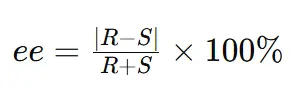
where R and S represent the amounts (or percentages) of the two enantiomers.
Enantiomer Associated Concept:
Diastereomer Definition: One of a pair of non-superimposable mirror-image stereoisomers.
Context: Enantiomers may differ in PK/PD and toxicity; single-enantiomer drugs are often preferred.
Example: S-ibuprofen (eutomer) vs R-ibuprofen (distomer).
Related Terms: Racemate, Eutomer, Distomer.
Reference: Morrison & Boyd, Organic Chemistry.
Enantiomeric Excess (ee)
Definition: The absolute difference in enantiomer fractions (|%R − %S|).
Context: Standard QC metric for chiral purity in pharma.
Example: 70% R, 30% S → 40% ee.
Related Terms: Enantiomeric Ratio, Optical Purity.
Reference: IUPAC Gold Book.
Enantiomeric Ratio (er)
Definition: The ratio of enantiomers, typically expressed as R:S.
Context: Preferred over ee for statistical modeling and kinetics.
Example: 98:2 e.r. for a product.
Related Terms: Enantiomeric Excess, dr.
Reference: IUPAC Gold Book.
Enantiomerization
Definition: Interconversion between enantiomers via bond rotation or reversible processes.
Context: Defines shelf-life and handling conditions for atropisomeric drugs.
Example: Biaryl axis rotation over barrier ΔG‡.
Related Terms: Racemization, Barrier to Rotation.
Reference: IUPAC Gold Book.
Enantiopure (Enantiomerically pure)
Associated Concept:
Scalemic Mixture |
Racemic Mixture
Definition: A chiral substance that contains only one enantiomer, with an enantiomeric excess (ee) of essentially 100%. In an
enantiopure sample, the opposite enantiomer is absent or present only in negligible trace amounts.
Context: Enantiopure compounds are highly valued in pharmaceutical, agrochemical, and fine chemical industries because the two
enantiomers of a chiral molecule can exhibit markedly different biological, pharmacological, toxicological, or
environmental behaviors. Advances in asymmetric synthesis, chiral resolution, and chiral chromatography have enabled the
production of enantiopure substances on both laboratory and industrial scales. Regulatory agencies often require
separate evaluation of individual enantiomers when stereochemistry significantly influences efficacy or safety.
Example: The proton-pump inhibitor Esomeprazole consists exclusively of the S-enantiomer of omeprazole and is therefore an
enantiopure drug. Similarly, Levofloxacin is the enantiopure S-enantiomer of ofloxacin.
Related Terms: Enantiomer, Enantioenriched, Racemate, Chiral Purity, Enantiomeric Excess (ee), Asymmetric Synthesis, Chiral Resolution.
Reference: Eliel, E. L., Wilen, S. H., & Doyle, M. P. (1994). Basic Organic Stereochemistry. New York: John Wiley & Sons. ISBN:
978-0471374993; Jacques, J., Collet, A., & Wilen, S. H. (1994). Enantiomers, Racemates, and Resolutions. Krieger
Publishing Company, Malabar, Florida. ISBN: 978-0894648282; Carey, F. A., & Sundberg, R. J. (2007). Advanced Organic
Chemistry, Part A: Structure and Mechanisms (5th ed.). Springer. ISBN: 978-0387448979; IUPAC Compendium of Chemical
Terminology (Gold Book). Definition of "Enantiomerically Pure" and related stereochemical terminology. Published by the
International Union of Pure and Applied Chemistry.
Enantioselective Metabolism
Definition: Metabolic pathways that preferentially process one enantiomer.
Context: Causes distinct clearance and exposure for enantiomers.
Example: CYP-mediated oxidation of one enantiomer faster than the other.
Related Terms: Stereopharmacology, Chiral Inversion.
Reference: Testa & Krämer, Drug Metabolism (2008).
Enantioselectivity
Definition: Preference for formation of one enantiomer over the other (quantified as ee or er).
Context: Primary performance metric in asymmetric synthesis and catalysis.
Example: 98:2 e.r. in asymmetric hydrogenation.
Related Terms: Stereoselectivity, Enantiospecificity.
Reference: Noyori, Nobel Lecture (2001).
Enantiospecificity
Definition: A reaction in which the enantiomeric identity of the product is determined by that of the starting material.
Context: Key in stereoretentive cross-couplings and biosynthetic steps.
Example: Stereoretentive substitution maintaining configuration.
Related Terms: Stereospecificity, Enantioselectivity.
Reference: IUPAC Gold Book.
Enantiotopic
Associated Concept:
Diastereotopic
Definition: A term describing two identical atoms, groups, or faces within the same achiral molecule that are related by mirror symmetry and whose replacement or reaction leads to a pair of enantiomers.
Context: Enantiotopic groups are chemically equivalent in an achiral environment and therefore usually exhibit identical physical and spectroscopic properties (e.g., a single NMR signal). However, they become distinguishable in a chiral environment, such as in the presence of a chiral reagent, catalyst, enzyme, solvent, or receptor. The concept of enantiotopicity is fundamental to prochirality, asymmetric synthesis, and enzyme stereospecificity.
Example: The two hydrogen atoms of the CH?OH group in ethanol are enantiotopic. Replacing one hydrogen with deuterium produces one enantiomer, whereas replacing the other produces its mirror image.
Related Terms: Diastereotopic, Homotopic, Prochirality, Pro-R, Pro-S, Re/Si Face, Stereotopicity, Enantiomer.
Reference: Eliel, E. L., Wilen, S. H., & Doyle, M. P. (1994). Basic Organic Stereochemistry. New York: John Wiley & Sons. ISBN: 978-0471374993; Clayden, J., Greeves, N., & Warren, S. (2012). Organic Chemistry (2nd ed.). Oxford University Press. ISBN: 978-0199270294; Anslyn, E. V., & Dougherty, D. A. (2006). Modern Physical Organic Chemistry. University Science Books. ISBN: 978-1891389314.
International Union of Pure and Applied Chemistry. Compendium of Chemical Terminology (Gold Book) - Entries on enantiotopicity, prochirality, and stereotopicity.
Key Distinction
Homotopic Groups: Replacement of either group produces identical molecules; chemically and spectroscopically equivalent.
Enantiotopic Groups: Replacement of either group produces enantiomers; equivalent in achiral environments but distinguishable in chiral environments.
Diastereotopic Groups: Replacement of either group produces diastereomers; chemically and spectroscopically non-equivalent even in achiral environments.
Pro-R / Pro-S: Labels assigned to enantiotopic atoms or faces according to the configuration that would result if one were preferentially substituted.
Key Insight:
Enantiotopicity is a manifestation of prochirality. Although enantiotopic groups are indistinguishable in ordinary (achiral) chemical environments, biological systems and asymmetric catalysts can differentiate between them, enabling stereoselective reactions and the formation of a single enantiomer. This principle underlies many enzymatic transformations and asymmetric syntheses.
Epimer
Narrower Concept:
Anomer
Definition: Diastereomers differing in configuration at only one stereocenter.
Context: Widespread in sugar chemistry and biologically relevant isomers.
Example: D-glucose vs D-mannose (C2 epimers).
Related Terms: Anomer, Diastereomer.
Reference: IUPAC Gold Book.
Equatorial Bond
Definition: A bond directed outward from the equator of a cyclohexane ring, approximately in the ring plane.
Context: Equatorial positions minimize steric hindrance; preferred by bulky substituents.
Example: Equatorial t-Bu in tert-butylcyclohexane.
Related Terms: Axial Bond, Conformation, A-Values.
Reference: Eliel & Wilen (1994).
Erythro-
Definition: A relative stereochemical descriptor for diastereomers with two adjacent chiral centers having substituents on the same side in a Fischer projection.
Context: Commonly used for sugars and amino acids; denotes visual similarity to erythrose.
Example: Erythro-2,3-butanediol has hydroxyl groups on the same side.
Related Terms: Threo-; Relative Configuration; Diastereomer.
Reference: Eliel, E. L. & Wilen, S. H. Stereochemistry of Organic Compounds. Wiley, 1994.
Eudismic Ratio
Definition: The ratio of pharmacological activity of the eutomer (more active enantiomer) to the distomer.
Context: Quantifies the stereochemical contribution to drug action, guiding chiral switch strategies.
Example: S-citalopram vs R-citalopram potency ratio.
Related Terms: Eutomer, Distomer, Stereopharmacology.
Reference: Ariëns, Med. Res. Rev. (1984).
Eutomer
Associated Concept:
Distomer
Definition: The enantiomer of a chiral drug that exhibits the greater desired pharmacological activity or therapeutic potency at the target receptor or biological system.
Context: In many chiral drugs, one enantiomer interacts more favorably with a biological target because of stereoselective recognition. This more active enantiomer is termed the eutomer, while the less active or less desirable enantiomer is called the distomer. The potency difference between the two is commonly expressed as the eudismic ratio (the ratio of the activity of the eutomer to that of the distomer). Identifying the eutomer is an important consideration in chiral drug development, regulatory evaluation, and chiral switch strategies.
Example: S-Ibuprofen is the eutomer because it is primarily responsible for the inhibition of cyclooxygenase (COX) enzymes and the anti-inflammatory activity of ibuprofen. The R-enantiomer is the distomer, although it undergoes partial metabolic inversion to the active S-enantiomer in vivo.
Related Terms: Distomer, Eudismic Ratio, Enantiomer, Chiral Drug, Racemate, Chiral Switch, Enantiopure Drug.
Reference: Ariens, E. J. (1984). "Stereochemistry, a Basis for Sophisticated Nonsense in Pharmacokinetics and Clinical Pharmacology." European Journal of Clinical Pharmacology, 26, 663-668;
Ariens, E. J. (1986). "Stereochemistry: A Source of Problems in Medicinal Chemistry." Medicinal Research Reviews, 6(4), 451-466; Nguyen, L. A., He, H., & Pham-Huy, C. (2006). "Chiral Drugs: An Overview." International Journal of Biomedical Science, 2(2), 85-100; Smith, S. W. (2009). "Chiral Toxicology: It's the Same Thing... Only Different." Toxicological Sciences, 110(1), 4-30.
Key Distinction
Eutomer: The enantiomer with the greater desired pharmacological activity or therapeutic effect.
Distomer: The enantiomer with lower activity, no activity, different activity, or potentially undesirable effects.
Eudismic Ratio: The ratio of the potency of the eutomer to that of the distomer.
Enantiopure Drug: A drug containing only one enantiomer, which is often (but not always) the eutomer.
Key Insight:
A eutomer is defined by its superior therapeutic activity, not by its absolute configuration (R or S). Depending on the drug, either the R-enantiomer or the S-enantiomer may be the eutomer. The designation therefore reflects biological performance, not stereochemical nomenclature.
Exciton Chirality Method
Definition: Assigns absolute configuration from sign of ECD exciton couplets between interacting chromophores.
Context: Widely applied to biaryls and helicenes.
Example: Positive couplet → P helicity.
Related Terms: ECD, Exciton Coupling.
Reference: Harada & Nakanishi (1972).
Exciton Coupling
Definition: Interaction between transition dipoles of nearby chromophores causing split CD signals.
Context: Exciton-chirality method assigns absolute configuration in biaryl and helicene systems.
Example: Couplet sign in BINOL indicating axial chirality sense.
Related Terms: ECD, Cotton Effect.
Reference: Harada & Nakanishi, Acc. Chem. Res. (1972).
F
Felkin–Anh Model
Definition: Predicts nucleophilic attack on carbonyls favoring approach anti to the largest substituent.
Context: Standard model for 1,2-asymmetric induction.
Example: Addition to α-chiral aldehydes.
Related Terms: Cram’s Rule, Bürgi–Dunitz Angle.
Reference: Anh & Felkin, Tetrahedron Lett. (1973).
Fischer Projection
Definition: A 2D representation where horizontal lines indicate bonds projecting forward and vertical lines project backward.
Context: Standard tool in carbohydrate and amino acid stereochemistry.
Example: D-glucose drawn in Fischer projection.
Related Terms: Newman Projection, Sawhorse Projection.
Reference: Fischer, Ber. Dtsch. Chem. Ges. (1891).
Flack Parameter (x)
Definition: Refinement parameter indicating correct absolute structure in X-ray crystallography.
Context: x ~ 0 confirms correct absolute configuration; x ~ 1 suggests inversion.
Example: Reporting Flack x for a chiral API crystal.
Related Terms: Absolute Configuration, X-ray Crystallography.
Reference: Flack, Acta Cryst. A (1983).
G
Gauche
Definition: A conformation in which substituents on adjacent carbons are separated by a dihedral angle of approximately 60°.
Context: Important in determining conformational energy and intramolecular interactions such as the gauche effect.
Example: Gauche butane conformation is less stable than anti but more stable than eclipsed.
Related Terms: Anti; Synclinal; Conformation; Newman Projection.
Reference: Eliel & Wilen (1994).
Geminal
Definition: Refers to two substituents attached to the same atom, typically a carbon.
Context: Geminal dihalides or diols exhibit distinct reactivity compared to vicinal analogs.
Example: Geminal dichlorides (R2CCl2) vs vicinal dichlorides (RCHCl-CH2Cl).
Related Terms: Vicinal; Substituent; Structural Isomer.
Reference: IUPAC Gold Book (2019).
Geometric Isomerism
Definition: Stereoisomerism due to restricted rotation (double bonds, rings).
Context: Controls pharmacology through spatial disposition of groups.
Example: cis/trans-platin complexes.
Related Terms: E/Z Isomerism, Ring Conformations.
Reference: IUPAC Gold Book.
GPCR Stereoselectivity
Definition: Enantiomer-dependent binding and signaling at GPCRs.
Context: Explains potency and bias differences across enantiomers.
Example: L- vs D-ligands at opioid receptors.
Related Terms: Stereopharmacology, Eutomer/Distomer.
Reference: Kenakin, Pharmacology Primer (2019).
H
Hashed (Wedge-Dash Representation)
Definition: A visual notation in molecular drawings where hashed bonds represent bonds going behind the plane of the paper.
Context: Used to depict stereochemistry in three-dimensional projections.
Example: Hashed bond to indicate the backward substituent in Fischer or wedge projections.
Related Terms: Wedged; Fischer Projection; Newman Projection.
Reference: Morrison & Boyd. Organic Chemistry. Prentice Hall, 1992.
Helical Chirality
Broader Concept:
Chirality
Associated Concept:
Planar Chirality
Definition: A form of stereoisomerism arising from the three-dimensional screw-like arrangement of atoms or molecular subunits, producing non-superimposable mirror-image structures distinguished by opposite helical handedness rather than a conventional stereogenic center.
Context: Helical chirality occurs when molecular architecture adopts a stable spiral or helical geometry that cannot be superimposed onto its mirror image. Unlike classical point chirality, which originates from tetrahedral stereogenic centers, helical chirality emerges from overall molecular topology and spatial organization.
Helical chirality is commonly observed in: Helicenes (ortho-fused aromatic systems);
Peptides and proteins (α-helices, collagen helices); DNA and RNA structures; Helical polymers; Supramolecular assemblies; Foldamers; Chiral nanomaterials
Helical chirality is typically designated using: P (plus, right-handed) - clockwise screw sense; M (minus, left-handed) - counterclockwise screw sense; The stereochemical stability depends upon the barrier to helix inversion; sufficiently high inversion barriers permit isolation of distinct enantiomeric helices.
Helical chirality influences: Molecular recognition; Circular dichroism (CD); Circularly polarized luminescence (CPL); Chiral catalysis; Biomolecular folding; Materials optical properties; Protein-ligand interactions
Example: DNA predominantly adopts a right-handed B-form helix, [6]Helicene exists as separable P and M enantiomeric helices, α-Helices in proteins are overwhelmingly constructed from L-amino acids, contributing to biological homochirality.
Related Terms: Helicity (P/M); Axial Chirality; Topological Chirality; Homochirality; Conformational Chirality; Foldamers; Chiral Materials
Reference: IUPAC. Compendium of Chemical Terminology (IUPAC Gold Book). 2nd Edition, 1997 (updated 2019).
Yashima, E.; Maeda, K.; Iida, H.; Furusho, Y.; Nagai, K. Helical Polymers: Synthesis, Structures, and Functions. Chemical Reviews, 109, 6102-6211 (2009).
Eliel, E. L.; Wilen, S. H. Stereochemistry of Organic Compounds. Wiley, New York (1994).
Helicity (P/M)
Definition: Screw sense of helical molecules designated P (plus) or M (minus).
Context: Describes helicenes and protein helices relevant to binding.
Example: P-helicene vs M-helicene.
Related Terms: Axial Chirality, Planar Chirality.
Reference: IUPAC Gold Book.
Heterochiral
Associated Concept:
Homochiral
Definition: Describing a molecular system, assembly, crystal, material, or mixture containing both enantiomeric forms, or chiral components of opposite handedness.
Context: Heterochirality represents the coexistence of opposite stereochemical forms within the same system. In chemistry, heterochiral arrangements may exhibit distinct thermodynamic stability, crystal packing, supramolecular organization, and biological behavior compared with corresponding homochiral systems. In supramolecular chemistry and crystallography, heterochiral assemblies often compete with homochiral assemblies, and the balance between them can strongly influence material properties. In biological systems, heterochiral combinations are generally uncommon but can occur in specialized circumstances, such as D-amino acids in bacterial cell walls or synthetic peptide systems.
Example: A racemic crystal containing both R- and S-enantiomers in the same crystal lattice is a heterochiral assembly, A peptide containing both L- and D-amino acids is a heterochiral peptide.
Related Terms: Homochiral; Racemate; Scalemic Mixture; Mirror-Image Biology; Chiral Materials
Reference: Eliel, E. L.; Wilen, S. H. Stereochemistry of Organic Compounds. Wiley, New York (1994).
Homochiral
Associated Concept:
Heterochiral
Definition: Describing a molecular system, material, assembly, or population composed exclusively or predominantly
of a single enantiomeric form, such that all constituent chiral units possess the same handedness.
Context: Homochirality is one of the most fundamental characteristics of terrestrial life. Nearly all naturally
occurring proteins are constructed from L-amino acids, while nucleic acids contain D-ribose or D-deoxyribose sugars.
This remarkable stereochemical uniformity enables highly specific molecular recognition, enzyme catalysis,
self-assembly, and biological information transfer. Homochirality may occur at multiple levels: Molecular homochirality,
Supramolecular homochirality, Polymer homochirality, Crystal homochirality, Biological homochirality. The origin of
biological homochirality remains one of the major unresolved questions in chemistry and origins-of-life research.
Example: Natural proteins are homochiral because they are composed almost entirely of L-amino acids, DNA is
homochiral because its sugar backbone consists of D-sugars.
Related Terms: Homochirality; Heterochiral; Mirror-Image Biology; Chiral Recognition; Protein Homochirality
Reference: Blackmond, D. G. The Origin of Biological Homochirality. Cold Spring Harbor Perspectives in Biology,
2(5): a002147 (2010); Eliel, E. L.; Wilen, S. H. Stereochemistry of Organic Compounds. Wiley, New York (1994); Chen Y,
Ma W. The origin of biological homochirality along with the origin of life. PLoS Comput Biol. 2020 Jan 8;16(1):e1007592.
doi: 10.1371/journal.pcbi.1007592; Gal J (1998). "Problems of stereochemical nomenclature and terminology. The
homochiral controversy. Its nature, origins, and a proposed solution". Enantiomer. 3: 263-273; Gal J (1998). "On the
meaning and use of homochiral". Journal of Chromatography A. 829 (1-2): 417-418. doi:10.1016/s0021-9673(98)00845-0.
Historical Controversies and Terminological Notes
The term "homochiral" has not always been used consistently. Historically, several definitions appeared in the
literature:
Classical Usage: Homochiral commonly referred to systems composed entirely of one enantiomer.
Example: Pure L-alanine, Pure R-BINAP, A crystal containing only one enantiomorphic form
Expanded Usage: Later researchers extended the term to include: Homochiral assemblies, Homochiral crystal packing,
Homochiral supramolecular structures, Homochiral polymers and biomacromolecules. In these cases, homochirality refers to
collective stereochemical organization, not merely molecular composition.
Origins-of-Life Debate: A major controversy concerns whether biological homochirality arose through: Chance
fluctuation followed by amplification, Asymmetric autocatalysis (e.g., Soai reaction), Chiral crystallization phenomena,
Circularly polarized light, Weak-force parity violation, Extraterrestrial delivery of enantiomerically enriched
molecules. No consensus mechanism has yet been universally accepted.
Homochiral vs Enantiopure: These terms are often confused. Enantiopure: Refers to a single molecular species
consisting of one enantiomer. Homochiral: Refers to an entire system sharing the same handedness.
For example: Pure L-alanine -> both enantiopure and homochiral. A protein composed of many different L-amino acids
-> homochiral but not a single enantiopure molecular species. A crystal of pure R-BINAP -> homochiral. A racemic crystal
-> heterochiral.
ChiralPedia Insight
A useful mental model: Enantiopure describes a molecule. Homochiral describes a system. A vial of pure L-alanine is
enantiopure. A living cell built from millions of L-amino acids is homochiral.
One is a chemical composition. The other is an architectural principle of life itself. And that distinction turns
out to be one of the deepest mysteries in chemistry: nature did not merely choose chirality-it chose a side and then
never looked back.
Horeau Method
Definition: Indirect determination of ee via formation of meso/dl diesters.
Context: Historical approach for ee estimation.
Example: Horeau’s diacid anhydrides with alcohols.
Related Terms: Optical Purity, CDA.
Reference: Horeau, Tetrahedron (1961).
I
Iminium Catalysis
Definition: Activation of α,β-unsaturated carbonyls via chiral iminium ions.
Context: Enables enantioselective Michael additions and cycloadditions.
Example: MacMillan catalysts.
Related Terms: Organocatalysis, Enamine Catalysis.
Reference: MacMillan, Nature (2000).
In-Out Stereoisomerism
Broader Concept:
Stereoisomerism
Associated Concept:
Conformational Stereochemistry
Definition:
A form of stereoisomerism in which two stereoisomers differ in the orientation of a substituent or structural unit toward the interior ("in") or toward the exterior ("out") of a defined molecular framework. The in and out descriptors indicate relative three-dimensional orientation and are particularly useful for structurally constrained molecules.
Synonyms:
In-Out Isomerism; In-Out Stereoisomerism
Context:
In-out stereoisomerism is encountered mainly in rigid, bridged, polycyclic, and cage-like molecular systems, where the molecular framework restricts the possible orientations of substituents or functional groups. The in form has the relevant group directed toward the interior or concave region of the molecular framework, whereas the out form has it directed away from that region. Depending on the molecular architecture, the resulting stereoisomers may be diastereomeric or, in some cases, enantiomeric.
Example:
In a suitably rigid bridged or cage-like molecule, a substituent directed toward the interior of the molecular framework may be designated in, while the corresponding substituent directed toward the exterior is designated out. When the molecular framework prevents rapid interconversion, the in and out forms can exist as distinct stereoisomers.
Related Terms:
Stereoisomerism, Configuration, Conformation, Stereogenic Element, Bridged Bicyclic Systems, Cage Compounds, Endo-Exo Stereochemistry, Syn-Anti Stereochemistry.
Reference:
Eliel, E. L., Wilen, S. H., & Mander, L. N. (1994). Stereochemistry of Organic Compounds. John Wiley & Sons.
Additional References:
Clayden, J., Greeves, N., & Warren, S. Organic Chemistry. Oxford University Press.
March, J. Advanced Organic Chemistry: Reactions, Mechanisms, and Structure. Wiley.
IUPAC. Compendium of Chemical Terminology (Gold Book). Terminology relating to stereoisomerism and stereochemical descriptors.
Key Distinction
In-out stereoisomerism describes relative spatial orientation, not absolute configuration. The terms in and out indicate whether a group is directed toward or away from a defined molecular framework. They should therefore not be regarded as alternatives to R/S or E/Z descriptors.
Key Insight
The importance of in-out stereoisomerism lies in its ability to describe stereochemical differences that arise from molecular architecture and spatial confinement, particularly in rigid and polycyclic systems. It provides a useful vocabulary for describing stereoisomers whose three-dimensional relationships are not adequately conveyed by conventional configurational descriptors alone.
Isomer
Definition: A compound that shares the same molecular formula with another compound but differs in atomic connectivity or spatial arrangement.
Context: Isomers are classified into structural (constitutional) and stereoisomers, including enantiomers and diastereomers.
Example: Butane and isobutane are constitutional isomers; R- and S-lactic acid are enantiomers.
Related Terms: Isomerism; Stereoisomer; Constitutional Isomer.
Reference: IUPAC. Compendium of Chemical Terminology (IUPAC Gold Book), 2nd Edition, 1997 (updated 2019).
Isomeric Ballast
Definition: Non-pharmacologically active stereoisomeric portion of a racemic or stereoisomeric drug mixture.
Context: Regulatory agencies require understanding of ballast contribution to safety and efficacy.
Example: R-ibuprofen considered ballast in S-ibuprofen therapy.
Related Terms: Distomer, Racemate, Stereo-pharmacology.
Reference: Ariëns, Med. Res. Rev. (1986).
Isomeric Purity Specification
Definition: Quality specification defining acceptable levels of undesired stereoisomers.
Context: ICH Q6A expects justified limits for isomers with safety/efficacy impact.
Example: Limit of ≤0.5% distomer in eutomer API.
Related Terms: ICH Q6A, QC.
Reference: ICH Q6A (1999).
Isomerism
Definition: The phenomenon in which compounds share the same molecular formula but differ in structure or spatial arrangement.
Context: Forms the basis of structural and stereochemical diversity in organic and medicinal chemistry.
Example: Ethanol and dimethyl ether are structural isomers; cis- and trans-2-butene are geometric isomers.
Related Terms: Isomer; Stereoisomer; Constitutional Isomer; Enantiomer; Diastereomer.
Reference: IUPAC. Compendium of Chemical Terminology (IUPAC Gold Book), 2nd Edition, 1997 (updated 2019).
J
Jacobsen–Katsuki Epoxidation
Definition: Mn–salen-catalyzed asymmetric epoxidation of unfunctionalized alkenes.
Context: Expands epoxidation to substrates beyond allylic alcohols.
Example: Epoxidation of styrenes.
Related Terms: Asymmetric Catalysis, Epoxidation.
Reference: Jacobsen, JACS (1990/1991).
K
Kagan ML2 Model
Definition: Model rationalizing nonlinear ee effects via homochiral/heterochiral catalyst aggregates.
Context: Guides interpretation of catalyst behavior in development.
Example: Dimeric catalyst equilibria giving nonlinear plots.
Related Terms: Nonlinear Effects, Enantioselectivity.
Reference: Kagan, Acc. Chem. Res. (1997).
Karplus Relationship
Definition: Empirical relationship between vicinal ³J coupling and dihedral angle.
Context: Supports stereochemical assignment from NMR coupling constants.
Example: ³JHH ~ 10 Hz for anti arrangement.
Related Terms: J-Coupling, Conformation.
Reference: Karplus, J. Chem. Phys. (1959).
Kinetic Resolution (KR)
Associated Concept:
Dynamic Kinetic Resolution
Definition: A process in which the two enantiomers of a racemic mixture react at different rates with a chiral reagent, catalyst, enzyme, or biological system, leading to preferential conversion of one enantiomer while the other remains relatively unreacted.
Context: Kinetic resolution is one of the most widely used methods for obtaining enantiomerically enriched or enantiopure compounds. The separation arises from differences in reaction rates rather than differences in physical properties. Enzymatic resolutions (e.g., lipase-catalyzed esterifications), asymmetric catalytic transformations, and biotransformations are common examples. A classical kinetic resolution has a theoretical maximum yield of 50% for the desired enantiomer because only one enantiomer is selectively transformed while the other is recovered.
Example: The lipase-catalyzed esterification of racemic secondary alcohols often converts one enantiomer faster than the other, yielding an enantiomerically enriched ester and an enantiomerically enriched unreacted alcohol. Industrially, enzymatic kinetic resolution has been used in the preparation of chiral pharmaceutical intermediates.
Related Terms: Dynamic Kinetic Resolution (DKR), Chiral Resolution, Enantiomeric Excess (ee), Enantioselectivity, Racemate, Asymmetric Catalysis, Biocatalysis.
Reference: Kagan, H. B., & Fiaud, J. C. (1988). "Kinetic Resolution." Topics in Stereochemistry, 18, 249-330;
Faber, K. (2018). Biotransformations in Organic Chemistry (7th ed.). Springer. ISBN: 978-3319615227; Jacobsen, E. N., Pfaltz, A., & Yamamoto, H. (Eds.). (1999). Comprehensive Asymmetric Catalysis. Springer; International Union of Pure and Applied Chemistry. Compendium of Chemical Terminology (Gold Book) - Definitions related to kinetic resolution and stereoselective reactions.
Key Distinction: Kinetic Resolution (KR): Separates enantiomers based on different reaction rates; maximum theoretical yield = 50% of the desired enantiomer.
Dynamic Kinetic Resolution (DKR): Combines kinetic resolution with in situ racemization of the slower-reacting enantiomer; theoretical yield can approach 100%.
Chiral Resolution: A broader term encompassing all methods used to separate enantiomers, including kinetic resolution.
Enantioselectivity: The preference for formation or consumption of one enantiomer over the other during a reaction.
L
L-(Laevus, Left)
Definition: A stereochemical prefix denoting configuration opposite to that of D-glyceraldehyde, based on the Fischer projection.
Context: Indicates mirror-image relationship to D-forms; unrelated to optical rotation (d/l).
Example: L-alanine corresponds to the configuration of L-glyceraldehyde.
Related Terms: D-; Fischer Projection; Absolute Configuration.
Reference: Fischer (1891).
Levo- (l, –)
Associated Concept:
Dextro-(d, +)
Definition: Denotes a compound that rotates plane-polarized light to the left (counter-clockwise).
Context: Paired with dextro-; unrelated to R/S assignment.
Example: L-(–)-lactic acid.
Related Terms: Dextro-, Optical Activity, Specific Rotation.
Reference: IUPAC Gold Book.
M
Matched Pair
Definition: Substrate and chiral reagent/catalyst whose stereochemical preferences reinforce each other.
Context: Delivers higher selectivity than mismatched combinations.
Example: (S)-substrate with (S)-auxiliary.
Related Terms: Mismatched Pair, Double Stereodifferentiation.
Reference: Seebach, Angew. Chem. (1979).
Memory of Chirality
Definition: Retention of stereochemical information through achiral or planar intermediates via conformational constraints.
Context: Enables net stereospecificity where racemization might be expected.
Example: Acylium ion cyclizations retaining chirality.
Related Terms: Stereomutation, Enantiospecificity.
Reference: Houk, Angew. Chem. (2001).
Meso Compound
Definition: An achiral molecule with stereocenters and an internal plane/center of symmetry.
Context: No net optical activity, important in planning stereoselective routes.
Example: Meso-tartaric acid.
Related Terms: Symmetry, Diastereomer.
Reference: Eliel & Wilen (1994).
Meso-
Definition: A molecule containing stereocenters but overall achiral due to an internal plane or center of symmetry.
Context: Meso compounds are optically inactive even though they contain chiral atoms.
Example: Meso-tartaric acid.
Related Terms: Achiral; Symmetry; Diastereomer.
Reference: Eliel & Wilen (1994).
Mirror Bias
Definition: A systematic preference, assumption, or neglect arising from treating mirror-image stereoisomers as functionally equivalent when they are not.
Context: Mirror bias often manifests as an implicit assumption that enantiomers behave similarly in biological systems, leading to underestimation of differences in potency, toxicity, metabolism, or signaling. Historically, mirror bias contributed to delayed recognition of enantioselective drug effects.
Example: Assuming a racemic drug's clinical profile reflects both enantiomers equally, despite one being pharmacologically dominant or toxic.
Related Terms: Chiral Neglect; Eutomer; Distomer; Stereo-pharmacology; Stereo-Sloppy
Reference: Hutt, A. J.; Caldwell, J. The importance of stereochemistry in drug action and disposition. Pharmacology & Therapeutics, 29, 245-263 (1985).
Ariens, E. J., Stereochemistry, a basis for sophisticated nonsense in pharmacokinetics and clinical pharmacology, European Journal of Clinical Pharmacology, 26, 663-668, (1984)
DOI: 10.1007/BF00541922
Demonstrates how ignoring enantiomeric differences leads to systemic scientific error - a direct conceptual root of mirror bias.
Misassignment of Configuration
Definition: The incorrect determination, description, or reporting of the absolute or relative stereochemical configuration of a molecule, stereogenic center, axis, or element.
Context: Misassignment of configuration can arise from incorrect application of CIP rules, misinterpretation of spectroscopic or crystallographic data, inappropriate use of chiroptical methods, or confusion between nomenclature systems (e.g., R/S vs D/L vs d/l). In pharmaceutical and medicinal chemistry, such errors can propagate through literature, patents, regulatory submissions, and clinical interpretation, leading to flawed structure-activity relationships, incorrect biological conclusions, or costly redevelopment.
Example: Assigning an alcohol as (R) based solely on optical rotation without corroborating evidence, later corrected by X-ray crystallography or VCD analysis showing the (S) configuration.
Related Terms: Absolute Configuration; Relative Configuration; CIP Rules; Stereochemical Assignment; Chiral Literacy; Stereo-Sloppy.
Reference: IUPAC. Compendium of Chemical Terminology (IUPAC Gold Book). 2nd Edition, 1997 (updated 2019).
Harada, N.; Nakanishi, K. Circular Dichroism Spectroscopy-Exciton Coupling in Organic Stereochemistry. Accounts of Chemical Research, 5, 257-263 (1972).
Mismatched Pair
Definition: Substrate and chiral reagent/catalyst with opposing preferences.
Context: Reduces stereoselectivity; addressed by switching catalyst or substrate.
Example: (S)-substrate with (R)-auxiliary.
Related Terms: Matched Pair, Stereoselectivity.
Reference: Evans, JACS (1981).
Molar Rotation (Φ)
Definition: Specific rotation multiplied by molar mass.
Context: Allows comparison of chiroptical responses across compounds.
Example: Molar rotation trends within homologous series.
Related Terms: Specific Rotation, Optical Activity.
Reference: Barron, Molecular Light Scattering (2004).
Molecular Imprinting
Definition: Template-directed polymerization producing cavities complementary to a target enantiomer.
Context: Creates synthetic receptors for separations and sensing.
Example: Imprinted polymers for S-propranolol.
Related Terms: Chiral Recognition, CSP.
Reference: Sellergren, Chem. Rev. (2000).
Mosher’s Method
Definition: Use of MTPA esters/amides to assign absolute configuration by Δδ patterns.
Context: Gold-standard for alcohols and amines in small-molecule analysis.
Example: Δδ analysis of secondary alcohols.
Related Terms: CDA, NMR.
Reference: Dale & Mosher, JACS (1973).
N
Neighboring Group Participation (NGP)
Definition: Assistance by an adjacent group forming bridged intermediates that alter stereochemical outcome.
Context: Can cause retention or special selectivity in substitutions.
Example: Participation by acetoxy in solvolysis.
Related Terms: SN1, SN2.
Reference: March, Advanced Organic Chemistry (2007).
Newman Projection
Definition: A perspective representation viewing along a C–C bond, useful for analyzing conformations.
Context: Widely used in stereo-electronic analysis and to visualize torsional strain.
Example: Staggered vs eclipsed ethane conformations.
Related Terms: Sawhorse Projection, Conformation.
Reference: Newman, JACS (1952).
NOE/NOESY
Definition: Nuclear Overhauser effect experiments probing through-space proximities.
Context: Establishes relative configuration and conformation.
Example: NOESY on cyclic diols.
Related Terms: J-Coupling, ROESY.
Reference: Claridge, High-Resolution NMR (2009).
Nonlinear Effects in Asymmetric Catalysis
Definition: Nonlinear relationship between catalyst ee and product ee due to catalyst aggregation or kinetics.
Context: Impacts process scale-up and control strategies.
Example: Kagan’s ML2 model.
Related Terms: Kagan Model, Enantioselectivity.
Reference: Kagan & Blackmond, Acc. Chem. Res. (2000).
Noyori Hydrogenation
Definition: Asymmetric hydrogenation via bifunctional Ru/diamine catalysts.
Context: Industrial method for enantioenriched alcohols and amines.
Example: Hydrogenation of ketones with Ru-BINAP/diamine.
Related Terms: Asymmetric Catalysis, Transfer Hydrogenation.
Reference: Noyori, Angew. Chem. (1994/2001).
O
Oppolzer Sultam
Definition: A rigid chiral auxiliary derived from camphor used to control facial selectivity.
Context: Useful for Diels–Alder and alkylation reactions with high selectivity.
Example: Sultam-controlled cycloadditions.
Related Terms: Chiral Auxiliary, Asymmetric Synthesis.
Reference: Oppolzer, Tetrahedron (1987).
Optical Activity
Definition: Rotation of plane-polarized light by chiral substances.
Context: Classical signature of chirality; still used for QC when specific rotation is compendial.
Example: [α]D^20 measurements for amino acids.
Related Terms: Polarimetry, Specific Rotation.
Reference: Atkins, Physical Chemistry.
Optical Activity
Definition: The ability of chiral substances to rotate the plane of polarized light.
Context: Classical indicator of chirality; measured via polarimetry to assess enantiomeric purity.
Example: (+)-Lactic acid rotates plane-polarized light to the right.
Related Terms: Optical Rotation; Specific Rotation; Polarimetry.
Reference: Atkins, P. W. Physical Chemistry. Oxford University Press, 2010.
Optical Purity
Definition: Measured enantiomeric purity derived from specific rotation relative to a pure enantiomer.
Context: Historical measure that correlates with ee when linear.
Example: Optical purity ≈ ee for simple systems.
Related Terms: Enantiomeric Excess, Polarimetry.
Reference: Morrison & Boyd.
Optical Rotation
Definition: The observed angle by which plane-polarized light is rotated upon passing through a chiral sample.
Context: Dependent on path length, concentration, wavelength, and temperature; denoted [α]D20.
Example: [α]D20 = +12.5° (c 1.0, MeOH).
Related Terms: Optical Activity; Specific Rotation; Polarimetry.
Reference: USP-NF General Chapter <781> Optical Rotation.
Optical Rotatory Dispersion (ORD)
Definition: Wavelength dependence of optical rotation.
Context: Precursor to CD; used for stereochemical assignment and conformational analysis.
Example: ORD curves distinguishing sugar stereoisomers.
Related Terms: Circular Dichroism, Cotton Effect.
Reference: Lightner & Gurst, Organic Conformational Analysis (1980).
Organocatalysis
Definition: Enantioselective catalysis with small organic molecules.
Context: Metal-free, green, and scalable approaches for key stereogenic steps.
Example: Proline-catalyzed aldol reactions.
Related Terms: Iminium Catalysis, Enamine Catalysis.
Reference: List & Barbas, JACS (2000).
P
Phase-Transfer Catalysis (PTC)
Definition: Biphasic catalysis moving anions across phases with chiral quaternary ammonium salts.
Context: Practical for large-scale enantioselective alkylations.
Example: Cinchona-derived PTCs.
Related Terms: Organocatalysis, Asymmetric Catalysis.
Reference: Starks, JACS (1971); O’Donnell, Acc. Chem. Res. (2004).
Pirkle-Type CSP
Definition: Small-molecule chiral selectors relying on π–π and H-bond interactions.
Context: Versatile for aromatic enantiomers and drug-like molecules.
Example: Whelk-O columns.
Related Terms: CSP, Chiral HPLC.
Reference: Pirkle, J. Chromatogr. (1981).
Planar Chirality
Broader Concept:
Chirality
Associated Concept:
Helical Chirality
Definition: Chirality resulting from the arrangement of substituents in a plane.
Context: Seen in ferrocene ligands and metallocenes used in asymmetric catalysis.
Example: Planar-chiral 1,2-disubstituted ferrocenes.
Related Terms: Helicity, Axial Chirality.
Reference: IUPAC Gold Book.
Polarimetry
Definition: Technique to measure optical rotation of chiral compounds.
Context: Rapid QC screen for enantiomeric composition when correlation is established.
Example: Measuring rotation of limonene enantiomers.
Related Terms: Optical Activity, Specific Rotation.
Reference: Atkins, Physical Chemistry.
Polysaccharide CSP
Definition: Derivatized cellulose/amylose selectors coated or immobilized on silica.
Context: Most widely used CSPs due to broad applicability.
Example: Chiralcel OD-H equivalents.
Related Terms: CSP, Chiral HPLC.
Reference: Okamoto, Chem. Rev. (2011).
Pro-R / Pro-S
Definition: Labels for enantiotopic groups whose replacement would give R or S product.
Context: Critical in enzymatic selectivity and NMR assignment.
Example: Pro-R hydrogen abstraction in alcohol dehydrogenase.
Related Terms: Prochirality, Re/Si Face.
Reference: IUPAC Gold Book.
Prochirality
Definition: An achiral entity that can become chiral by a single desymmetrizing step.
Context: Basis for enantioface/enantioselective reactions in synthesis and enzymology.
Example: Prochiral ketones undergoing enantioselective reduction.
Related Terms: Re/Si Face, Pro-R/Pro-S.
Reference: IUPAC Gold Book.
Protein Homochirality
Definition: Proteins are composed almost exclusively of L-amino acids.
Context: Drives stereoselective binding and metabolism in biology.
Example: Enzymes discriminating D- vs L-substrates.
Related Terms: Homochirality, Stereorecognition.
Reference: Blackmond, PNAS (2004).
Pseudoasymmetric Center (r/s)
Definition: A stereocenter whose configuration is defined relative to other stereocenters (lowercase r/s).
Context: Relevant in complex APIs where relayed stereochemistry affects labeling.
Example: r/s descriptors in substituted tartaric acid derivatives.
Related Terms: CIP Rules, Relative Configuration.
Reference: IUPAC Gold Book.
Q
Quadrant Model (Hydrogenation)
Definition: Empirical model mapping steric quadrants around metal–ligand catalysts to predict facial selectivity.
Context: Used with Rh-DuPHOS, BINAP-Ru systems for enantioface control.
Example: Asymmetric hydrogenation of dehydroamino acids.
Related Terms: Bite Angle, Chiral Ligand.
Reference: Knowles/Halpern analyses (1970s–1990s).
R
R/S Configuration
Definition: CIP-based descriptors assigning absolute configuration to stereocenters.
Context: Universal language for stereochemical specification in pharma and patents.
Example: S-ibuprofen is the active eutomer.
Related Terms: CIP Rules, Absolute Configuration.
Reference: Cahn–Ingold–Prelog rules (1956/1966).
Racemic Compound
Definition: Racemate that crystallizes as a single racemic crystal containing both enantiomers.
Context: Limits simple preferential crystallization; requires alternative resolution routes.
Example: Racemic mandelic acid (context dependent).
Related Terms: Racemate, Conglomerate.
Reference: Eliel & Wilen (1994).
Racemic Drug
Associated Concept:
Chiral Switch
Definition: A pharmaceutical product that contains equal amounts (1:1 ratio) of both enantiomers of a chiral drug,
forming a racemic mixture (racemate).
Context: Many chiral drugs were originally developed and marketed as racemates because synthesizing or separating
individual enantiomers was technically challenging and costly. However, the two enantiomers in a racemic drug may differ
significantly in pharmacological activity, pharmacokinetics, metabolism, toxicity, or side-effect profiles. Advances in
chiral synthesis and regulatory requirements have led to the development of several single-enantiomer versions of
previously marketed racemic drugs, a process known as a chiral switch.
Example: Ibuprofen is marketed as a racemic drug containing both R- and S-ibuprofen. The S-enantiomer is primarily
responsible for the anti-inflammatory activity, while the R-enantiomer undergoes partial metabolic conversion to the
active S-form in vivo.
Related Terms: Racemate, Enantiomer, Enantiopure Drug, Chiral Switch, Eutomer, Distomer, Stereoselectivity.
Reference: Ariens, E. J. (1984). "Stereochemistry, a Basis for Sophisticated Nonsense in Pharmacokinetics and
Clinical Pharmacology." European Journal of Clinical Pharmacology, 26, 663-668; Smith, S. W. (2009). "Chiral Toxicology:
It's the Same Thing... Only Different." Toxicological Sciences, 110(1), 4-30; Nguyen, L. A., He, H., & Pham-Huy, C.
(2006). "Chiral Drugs: An Overview." International Journal of Biomedical Science, 2(2), 85-100; International Union of
Pure and Applied Chemistry. Compendium of Chemical Terminology (Gold Book) - Definitions of racemate, enantiomer, and
chirality-related terms.
Key Distinction
| Term |
Characteristic |
| Racemic Drug |
Contains equal amounts of both enantiomers (50:50); ee = 0%. |
| Enantiopure Drug |
Contains only one enantiomer; ee ≈ 100%. |
| Enantioenriched Drug |
Contains one enantiomer in excess over the other; 0% < ee < 100%. |
| Chiral Switch |
Development of a single-enantiomer drug from a previously marketed racemic drug. |
Key Insight: A racemic drug is not necessarily inferior to an enantiopure drug. In some cases, both enantiomers
contribute
beneficially to therapeutic activity, whereas in others one enantiomer may be inactive or associated with adverse
effects. Consequently, the choice between a racemate and a single-enantiomer drug depends on scientific, clinical, and
regulatory considerations.
Racemic Mixture (Racemate)
Associated Concept:
Scalemic Mixture |
Enantiopure
Definition: A 1:1 mixture of enantiomers.
Context: Common synthetic outcome; may require resolution or chiral switching.
Example: Racemic thalidomide.
Related Terms: Conglomerate, Racemic Compound.
Reference: FDA Policy on Stereoisomeric Drugs (1992).
Racemization
Associated Concept:
Resolution (Chiral Resolution)
Definition: Conversion of an enantiopure substance to a racemate.
Context: Critical risk for chiral APIs and must be controlled in process/storage.
Example: Base-catalyzed racemization of α-chiral carbonyls.
Related Terms: Enantiomerization, Stereomutation.
Reference: IUPAC Gold Book.
Raman Optical Activity (ROA)
Definition: Difference in Raman scattering for circularly polarized light.
Context: Complementary to VCD; sensitive to conformation of chiral molecules and biomacromolecules.
Example: ROA of proteins to assess secondary structure.
Related Terms: VCD, CD.
Reference: Barron, Molecular Light Scattering (2004).
Re/Si Face
Definition: Descriptors for the two faces of a trigonal (sp²) center.
Context: Used to define enantioface selectivity in additions and reductions.
Example: Hydride attack on the Re face of a ketone.
Related Terms: Prochirality, Pro-R/Pro-S.
Reference: IUPAC Gold Book.
Relative Configuration
Associated Concept:
Absolute Configuration Definition: The spatial relationship between stereocenters within a molecule without reference to absolute R/S.
Context: Useful for assigning diastereomer series in synthesis and NMR analysis.
Example: Erythro vs threo in sugars.
Related Terms: Diastereomer, Absolute Configuration.
Reference: Eliel & Wilen (1994).
Relative Stereochemistry
Definition: The spatial relationship between stereocenters within a molecule without reference to absolute configuration.
Context: Important for describing diastereomers in synthesis and structure elucidation.
Example: Erythro and threo configurations of 2,3-butanediols.
Related Terms: Absolute Configuration; Diastereomer; Enantiomer.
Reference: Eliel & Wilen (1994).
Resolution (Chiral Resolution)
Broader Concept:
Chiral Separation
Associated Concept:
Asymmetric Synthesis
Definition: Resolution, also referred to as chiral resolution, is the process of separating the individual enantiomers of a racemic mixture to obtain one or both enantiomers in enantioenriched or enantiopure form.
Synonyms: Chiral Resolution; Optical Resolution (historical term); Enantiomeric Resolution.
Context: Resolution is one of the principal strategies for obtaining optically active compounds from racemic mixtures. Unlike asymmetric synthesis, which creates chirality during chemical synthesis, resolution begins with a racemate and separates its constituent enantiomers. Resolution may be achieved by classical methods (e.g., diastereomeric salt formation and fractional crystallization), chromatographic techniques using chiral stationary phases, enzymatic or kinetic resolution, dynamic kinetic resolution, or preferential crystallization. Resolution remains an indispensable technique in pharmaceutical development, agrochemical production, natural product isolation, and analytical chemistry.
Example: The enantiomers of ibuprofen can be resolved by chiral high-performance liquid chromatography (HPLC) using a chiral stationary phase. Alternatively, racemic amines may be resolved by forming diastereomeric salts with a chiral resolving agent, followed by fractional crystallization.
Related Terms: Classical Resolution, Kinetic Resolution, Dynamic Kinetic Resolution, Optical Resolution, Chiral Separation, Racemate, Enantiopure, Enantioenriched, Chiral Chromatography, Asymmetric Synthesis.
Reference: Jacques, J., Collet, A., & Wilen, S. H. (1994). Enantiomers, Racemates, and Resolutions. Krieger Publishing Company, Malabar, Florida. ISBN: 978-0894648282; Ahuja, S. (2000). Chiral Separation Methods for Pharmaceutical and Biotechnological Products. John Wiley & Sons. ISBN: 978-0471370308; Faber, K. (2018). Biotransformations in Organic Chemistry (7th ed.). Springer. ISBN: 978-3319615227; International Union of Pure and Applied Chemistry. Compendium of Chemical Terminology (Gold Book) - Entries on resolution and enantiomer separation.
Key Distinction
Resolution (Chiral Resolution): Separation of the enantiomers of a racemic mixture into individual enantiomers.
Chiral Separation: A broader term encompassing all methods used to separate enantiomers, whether from a racemate or an enantioenriched mixture.
Asymmetric Synthesis: Direct preparation of one enantiomer from achiral or prochiral starting materials using a chiral source.
Racemization: Conversion of an enantiomerically enriched or enantiopure compound into a racemic mixture, thereby reducing or eliminating enantiomeric excess.
Key Insight
Resolution is the classical and preferred stereochemical term for the separation of a racemic mixture into its constituent enantiomers. Since the process inherently involves chiral molecules, the adjective "chiral" is optional; therefore, Resolution and Chiral Resolution are generally regarded as synonymous in stereochemistry. The term Optical Resolution is an older synonym that originated from the historical use of optical rotation to distinguish and isolate enantiomers.
S
Sawhorse Projection
Definition: Representation of conformations showing a C–C bond diagonally with attached substituents.
Context: Useful for depicting stereochemical relationships and conformational preferences.
Example: Anti vs gauche butane.
Related Terms: Newman Projection, Conformation.
Reference: Eliel & Wilen (1994).
Scalemic Mixture
Associated Concept:
Racemic Mixture |
Enantiopure
Definition: A mixture with unequal amounts of enantiomers (non-racemic).
Context: Describes real-world batches before final enantiopurification and specifications.
Example: 90:10 e.r. mixture of a chiral API.
Related Terms: Enantiomeric Excess, Racemate.
Reference: IUPAC Gold Book.
Sharpless Dihydroxylation
Definition: OsO4/ligand (AD-mix) enantioselective dihydroxylation of alkenes.
Context: Delivers vic-diols with predictable configuration.
Example: AD-mix-α/β applications.
Related Terms: Sharpless Epoxidation, Asymmetric Catalysis.
Reference: Sharpless (2001).
Sharpless Epoxidation
Definition: Ti–tartrate-catalyzed enantioselective epoxidation of allylic alcohols.
Context: Workhorse method to install epoxides with high ee.
Example: Epoxidation to epothilone intermediates.
Related Terms: Asymmetric Catalysis, Sharpless Dihydroxylation.
Reference: Sharpless, Nobel Lecture (2001).
SN1 Racemization
Definition: Loss of configuration due to planar carbocation intermediate in SN1 reactions.
Context: Explains partial/complete racemization in solvolysis.
Example: Solvolysis of tert-butyl chloride.
Related Terms: SN1, Neighboring Group Participation.
Reference: Morrison & Boyd.
Soai Reaction
Definition: Asymmetric autocatalysis of pyrimidyl alkanol formation showing amplification from minute ee.
Context: Model system for origin-of-homochirality studies.
Example: Autocatalytic addition of diisopropylzinc to aldehydes.
Related Terms: Absolute Asymmetric Synthesis, Amplification.
Reference: Soai, Nature (1995).
Solid Solution (Racemic Solid Solution)
Definition: Crystalline phase where enantiomers are disordered over lattice sites.
Context: Challenging for resolution; may impact solid-state specifications.
Example: Racemic mixtures forming solid solutions.
Related Terms: Racemic Compound, Conglomerate.
Reference: Eliel & Wilen (1994).
Specific Rotation ([α]λ^T)
Definition: Observed optical rotation normalized to concentration and path length.
Context: Compendial test for chiral purity/identity in some monographs.
Example: [α]D^20 = +12.5 (c 1.0, MeOH).
Related Terms: Optical Activity, Polarimetry.
Reference: USP/Ph. Eur. General Chapters.
Spiranes
Definition: Bicyclic systems sharing a single atom; may be chiral without stereocenters.
Context: Offer rigid, 3D scaffolds for medicinal chemistry.
Example: Spiro[4.4]nonane derivatives.
Related Terms: Topological Chirality, Planar Chirality.
Reference: Clayden et al. (2012).
Stereo-Descriptors
Definition: Symbols, prefixes, suffixes, notations, and nomenclature conventions used to specify the stereochemical identity, spatial arrangement, or relative orientation of atoms and substituents within a molecule.
Context: Stereo-descriptors form the language of stereochemistry and are essential for unambiguous communication in organic chemistry, medicinal chemistry, pharmaceutical development, natural products chemistry, and regulatory documentation. They distinguish stereoisomers that possess identical molecular formulas and connectivity but differ in three-dimensional arrangement.
Stereo-descriptors may define: Absolute stereochemistry: R / S - absolute configuration at stereogenic centers; E / Z - double bond geometry; P / M - helicity
Ra / Sa - axial chirality; RP / SP - planar chirality; r / s - pseudoasymmetric centers
Relative stereochemistry: syn / anti; erythro / threo; cis / trans; meso; D / L. Optical descriptors: (+) / (-); dextro- / levo-. Projection-based stereochemical representation:
Wedged bond; Hashed bond; Fischer projection; Newman projection; Sawhorse projection. Zig-zag representation.
Accurate use of stereo-descriptors is fundamental to avoiding misassignment of configuration, maintaining stereo-hygiene, and preserving chiral fidelity.
Example: (S)-ibuprofen specifies absolute stereochemistry using the CIP system, whereas D-glucose uses relative stereochemical assignment relative to glyceraldehyde. E-tamoxifen specifies alkene geometry.
Related Terms: Absolute Configuration; Relative Configuration; CIP Rules; Stereogenic Center; Stereochemistry; Misassignment of Configuration; Stereo-Hygiene
Reference: IUPAC. Compendium of Chemical Terminology (IUPAC Gold Book). 2nd Edition, 1997 (updated 2019).
Cahn, R. S.; Ingold, C. K.; Prelog, V. Specification of Molecular Chirality. Angewandte Chemie International Edition, 5, 385-415 (1966).
Eliel, E. L.; Wilen, S. H. Stereochemistry of Organic Compounds. Wiley, New York (1994).
Stereo-Hygiene
Definition: A best-practice mindset and operational discipline aimed at preventing stereochemical errors, ambiguity, or degradation in chemical and pharmaceutical work.
Context: Stereo-hygiene encompasses correct nomenclature usage, explicit stereochemical specification, proper analytical controls, avoidance of configurational ambiguity, and routine checks for racemization or epimerization. It is the practical countermeasure to stereo-sloppy behavior.
Example: Explicitly reporting configuration (R/S), enantiomeric ratio, analytical method, and conditions that could induce racemization in experimental sections and regulatory filings.
Related Terms: Stereo-Sloppy; Chiral Literacy; Misassignment of Configuration; Stereochemical Due Diligence
Reference: Ariens, E. J. Stereochemistry, a basis for sophisticated nonsense in pharmacokinetics and clinical pharmacology. Medical Research Reviews, 4, 197-236 (1984).
Ariens EJ. Stereochemistry, a basis for sophisticated nonsense in pharmacokinetics and clinical pharmacology. Eur J Clin Pharmacol. 1984, 26, 663-668. DOI: 10.1007/BF00541922
These works expose what happens when chiral hygiene is absent-misleading PK/PD data and unsafe assumptions.
Stereo-Sloppy
Definition: An informal but precise descriptor for scientific, educational, or regulatory practice in which stereochemical distinctions are ignored, misused, oversimplified, or treated as inconsequential.
Context: Stereo-sloppy behavior manifests when chirality, configuration, or isomerism is inadequately specified or misunderstood. In chemistry and pharmacology, stereo-sloppiness can lead to incorrect structures, flawed SAR conclusions, irreproducible synthesis, analytical errors, or unsafe clinical assumptions. The term is particularly relevant in discussions of poor stereochemical literacy, inadequate reporting, and historical drug development failures.
Example: Describing a compound as "the active drug" without specifying whether it is a racemate, eutomer, or enantiopure form; or using D/L, d/l, and R/S interchangeably as if they were equivalent.
Related Terms: Chiral Literacy; Chiral Intelligence; Stereochemistry; Isomerism; Stereo-pharmacology; Misassignment of Configuration.
Reference: Ariens, E. J. Stereochemistry, a basis for sophisticated nonsense in pharmacokinetics and clinical pharmacology. Medical Research Reviews, 4, 197-236 (1984). - Classic paper criticizing careless stereochemical thinking.
Eliel, E. L., Wilen, S. H., & Mander, L. N. Stereochemistry of Organic Compounds. Wiley (1994).
Smith, S. W. Chiral toxicology: it's the same thing...only different. Toxicological Sciences, 110(1), 4-30, (2009).
Nguyen, L. A., He, H., & Pham-Huy, C. Chiral drugs: an overview. International Journal of Biomedical Science, 2(2), 85-100, (2006).
Stereocenter
Definition: An atom at which interchange of two substituents produces a stereoisomer.
Context: Defines loci of stereochemical variation and controls stereochemical outcomes in synthesis.
Example: Tetrahedral carbon with four different substituents.
Related Terms: Chiral Center, Stereogenic Center.
Reference: IUPAC Gold Book.
Stereochemical Collapse
Definition: The loss, degradation, oversimplification, or failure to preserve stereochemical information during artificial intelligence (AI), machine learning (ML), computational modeling, or molecular representation workflows, resulting in chemically distinct stereoisomers being treated as equivalent or inadequately differentiated.
Context: In AI/ML systems for chemistry and drug discovery, stereochemical collapse occurs when molecular representations, embeddings, descriptors, fingerprints, tokenization schemes, or training datasets insufficiently encode stereochemistry. This can cause enantiomers, diastereomers, atropisomers, or conformationally relevant stereoisomers to become computationally indistinguishable despite possessing substantially different pharmacological, toxicological, or physicochemical properties.
Stereochemical collapse becomes particularly important in:
Molecular foundation models; SMILES-based language models; QSAR and QSPR workflows; Generative AI for drug design; Retrosynthesis planning; Molecular property prediction; Protein-ligand affinity prediction; Virtual screening systems
The phenomenon can propagate systematic error, producing incorrect structure-activity relationships (SAR), inaccurate potency predictions, poor stereoselective optimization, or unsafe compound prioritization.
Example: An ML model trained on molecular fingerprints that inadequately encode stereochemistry predicts similar biological activity for (R)-thalidomide and (S)-thalidomide, despite profound stereochemical differences in biological outcome.
Another example is loss of stereochemical markers during canonicalization or representation compression, causing distinct chiral molecules to converge toward similar latent-space embeddings.
Related Terms: Chiral Intelligence; Stereo-Hygiene; Mirror Bias; Chiral Fidelity; Molecular Representation Learning; Stereopharmacology; Stereochemical Assignment
Reference: Schneider, G.; Clark, D. E. Automated De Novo Drug Design: Are We Nearly There Yet? Angewandte Chemie International Edition, 58, 10792-10803 (2019).
Gawehn, E.; Hiss, J. A.; Schneider, G. Deep Learning in Drug Discovery. Molecular Informatics, 35, 3-14 (2016).
Tetko, I. V. et al. State-of-the-Art Augmented NLP Transformer Models for Direct and Single-Step Retrosynthesis. Nature Communications, 11, 5575 (2020).
Stereochemistry
Definition: The branch of chemistry concerned with the three-dimensional arrangement of atoms in molecules and its influence on properties and reactions.
Context: Central to understanding drug action, synthesis outcomes, and regulatory specifications for isomeric purity.
Example: E/Z isomers of tamoxifen show distinct properties.
Related Terms: Chirality, Configuration, Conformation.
Reference: Eliel & Wilen (1994).
Stereodivergent Synthesis
Definition: Strategy enabling access to multiple stereoisomers via controlled catalyst/condition changes.
Context: Efficient generation of stereochemical arrays for SAR.
Example: Catalyst-controlled divergent aldol products.
Related Terms: Enantiodivergence, Diastereodivergence.
Reference: Wang & List, Angew. Chem. (2012).
Stereoelectronic Effect
Definition: Effect of orbital alignment on conformation and reactivity.
Context: Controls anomeric effect, β-elimination geometry, and selectivity.
Example: Anomeric effect in carbohydrates.
Related Terms: Antiperiplanar, Hyperconjugation.
Reference: Deslongchamps, Stereoelectronic Effects (1983).
Stereogenic Axis (Axis of Chirality)
Definition: A linear element in a molecule that gives rise to chirality due to restricted rotation.
Context: Common in atropisomeric systems and cumulenes like allenes.
Example: Axially chiral biaryl ligands such as BINAP.
Related Terms: Atropisomerism; Axial Chirality; Planar Chirality.
Reference: IUPAC Gold Book (2019).
Stereogenic Center
Definition: An atom at which the interchange of two substituents generates a stereoisomer.
Context: Most often a tetrahedral carbon with four different substituents; key determinant of chirality in drugs.
Example: The α-carbon in lactic acid is a stereogenic center
Related Terms: Chiral Center; Stereocenter; Enantiomer.
Reference: IUPAC. Compendium of Chemical Terminology (IUPAC Gold Book), 2nd Edition, 1997 (updated 2019).
Stereogenic Element
Definition: Any structural feature (center, axis, plane, helix) that generates stereoisomerism.
Context: Extends chirality beyond tetrahedral centers to axes and planes common in drugs and ligands.
Example: Axial chirality in BINAP; planar chirality in ferrocene.
Related Terms: Axial Chirality, Planar Chirality, Helicity.
Reference: IUPAC Gold Book.
Stereoisomer(s)
Definition: Compounds with the same molecular formula and bonding sequence but differing in three-dimensional arrangement.
Context: Includes enantiomers and diastereomers, fundamental to stereochemistry and pharmacology.
Example: Cis/trans isomers of 2-butene; R- and S-lactic acid.
Related Terms: Enantiomer; Diastereomer; Isomerism.
Reference: IUPAC Gold Book (2019).
Stereomutation
Definition: Interconversion between stereoisomers (e.g., enantiomerization, epimerization).
Context: Impacts shelf life and bioactivity; must be profiled in stability studies.
Example: Atropisomer interconversion over time.
Related Terms: Racemization, Barrier to Rotation.
Reference: Clayden et al. (2012).
Stereopharmacology
Broader Concept:
Pharmacology
Associated Concept:
Chiral Pharmacology
Narrower Concepts:
Chiral Pharmacology
Definition: Stereopharmacology is the branch of pharmacology that investigates how the three-dimensional stereochemical structure of drug molecules influences their interactions with biological systems. It encompasses the effects of all forms of stereoisomerism-including chirality, geometric isomerism, atropisomerism, conformational isomerism, and other stereochemical features-on pharmacodynamics, pharmacokinetics, metabolism, toxicity, and therapeutic efficacy.
Context: Biological targets such as receptors, enzymes, ion channels, transport proteins, and nucleic acids are inherently three-dimensional and stereospecific. Consequently, differences in the stereochemistry of drug molecules can profoundly affect binding affinity, intrinsic activity, selectivity, absorption, distribution, metabolism, excretion, and toxicity. Stereopharmacology provides the conceptual framework for understanding these stereoselective interactions and plays a central role in modern drug discovery, medicinal chemistry, regulatory science, and precision therapeutics. Chiral pharmacology represents one of its most important sub-disciplines.
Example: The cis and trans isomers of tamoxifen exhibit different biological activities, while the (R)- and (S)-enantiomers of drugs such as ibuprofen and propranolol differ in pharmacological potency and disposition. These examples illustrate how stereochemistry, in its various forms, influences drug action.
Related Terms: Pharmacology, Chirality, Stereochemistry, Chiral Pharmacology, Enantiomer, Diastereomer, Geometric Isomerism, Atropisomerism, Conformational Isomerism, Stereoselectivity, Chiral Drug.
Reference: Hutt, A. J., & Caldwell, J. (1985). The importance of stereochemistry in drug action and disposition. Pharmacology & Therapeutics, 29(2), 245-263.
Ariens, E. J. (1984). Stereochemistry, a basis for sophisticated nonsense in pharmacokinetics and clinical pharmacology. European Journal of Clinical Pharmacology, 26, 663-668.
Caldwell, J. (1995). Chiral pharmacology and the regulation of new drugs. Chemistry and Industry, 6, 176-179.
Jamali, F., Mehvar, R., & Pasutto, F. M. (1994). Enantioselective Aspects of Drug Action and Disposition. Wiley.
Agranat, I., Caner, H., & Caldwell, J. (2002). Putting chirality to work: The strategy of chiral switches. Nature Reviews Drug Discovery, 1(10), 753-768.
Nguyen, L. A., He, H., & Pham-Huy, C. (2006). Chiral Drugs: An Overview. International Journal of Biomedical Science, 2(2), 85-100.
Smith, S. W. (2009). Chiral Toxicology: It's the Same Thing... Only Different. Toxicological Sciences, 110(1), 4-30.
Key Distinction (recommended for Chiralpedia)
Although the two terms are sometimes used interchangeably, stereopharmacology is the broader discipline, encompassing the influence of all forms of stereochemistry on drug action and disposition. Chiral pharmacology is a specialized branch that focuses specifically on the pharmacological consequences of molecular chirality and enantiomerism.
Stereoselective Binding
Definition: Preferential binding of one stereoisomer to a chiral target.
Context: Directly affects potency, efficacy, and safety.
Example: One enantiomer with higher affinity to an enzyme active site.
Related Terms: Chiral Recognition, Stereopharmacology.
Reference: Silverman, Drug Design (2014).
Stereoselective Transport
Definition: Transporters recognizing one enantiomer with higher affinity.
Context: Affects absorption/distribution differences between enantiomers.
Example: OATP transport of certain eutomer predominates.
Related Terms: Stereopharmacology, Pharmacokinetics.
Reference: Giacomini et al., Nat. Rev. Drug Discov. (2010).
Stereoselectivity
Definition: Formation of one stereoisomer in preference to others.
Context: Broad umbrella covering enantio- and diastereoselectivity; essential metric in route design.
Example: Syn- vs anti-aldol selectivity.
Related Terms: Enantioselectivity, Diastereoselectivity.
Reference: IUPAC Gold Book.
Stereospecificity
Definition: Different stereoisomeric reactants give different stereoisomeric products.
Context: Defines mechanistic pathways (e.g., SN2 inversion).
Example: Walden inversion in SN2 reactions.
Related Terms: Stereoselectivity, Enantiospecificity.
Reference: IUPAC Gold Book.
Structure-Activity Relationship (SAR)
Definition: The relationship between the chemical structure of a molecule and its biological or pharmacological activity. SAR studies examine how systematic changes in molecular structure influence potency, selectivity, efficacy, toxicity, pharmacokinetics, and other biological properties.
Synonyms: SAR; Structure-Biological Activity Relationship (less common).
Context: Structure-Activity Relationship (SAR) is a fundamental concept in medicinal chemistry, pharmaceutical sciences, and drug discovery. By synthesizing and evaluating structurally related compounds, researchers identify the molecular features responsible for biological activity and optimize lead compounds into safer and more effective drugs. SAR forms the scientific basis for lead optimization, bioisosteric replacement, activity cliff analysis, and quantitative structure-activity relationship (QSAR) modeling.
Example: Replacing a hydrogen atom with a fluorine atom, modifying a functional group, or altering stereochemistry may significantly affect a compound's receptor affinity, metabolic stability, or therapeutic potency. Such observations contribute to the development of a comprehensive SAR for a drug candidate.
Related Terms: Activity Cliff, Chirality Cliff, Quantitative Structure-Activity Relationship (QSAR), Lead Optimization, Bioisostere, Pharmacophore, Molecular Recognition.
Reference: Patrick, G. L. (2023). An Introduction to Medicinal Chemistry (7th ed.). Oxford University Press.
Additional References:
Wermuth, C. G. (Ed.). (2015). The Practice of Medicinal Chemistry (4th ed.). Academic Press.
Kubinyi, H. (1993). QSAR: Hansch Analysis and Related Approaches. VCH Publishers.
Silverman, R. B., & Holladay, M. W. (2014). The Organic Chemistry of Drug Design and Drug Action (3rd ed.). Academic Press.
Key Distinction
Structure-Activity Relationship (SAR): Describes the qualitative relationship between molecular structure and biological activity.
QSAR: Uses mathematical and statistical models to quantitatively predict biological activity from molecular descriptors.
Activity Cliff: A pronounced discontinuity within an SAR, where a minor structural modification produces a major change in biological activity.
Chirality Cliff: A stereochemistry-specific activity cliff caused solely by changes in chirality or stereochemical configuration.
Key Insight
Structure-Activity Relationship (SAR) provides the conceptual framework for understanding how molecular structure influences biological function. It is the cornerstone of rational drug design, enabling medicinal chemists to systematically optimize compounds for improved potency, selectivity, safety, and pharmacokinetic properties. Concepts such as activity cliffs and chirality cliffs highlight regions of an SAR where seemingly minor structural or stereochemical changes produce unexpectedly large biological effects.
Substituent
Definition: An atom or group of atoms attached to a parent chain or ring, replacing a hydrogen atom.
Context: Determines molecular properties, reactivity, and stereochemical effects.
Example: Methyl, nitro, and hydroxyl groups are common substituents.
Related Terms: Functional Group; Geminal; Vicinal.
Reference: IUPAC Gold Book (2019).
Syn (Stereochemical Descriptor)
Associated Concept:
Anti-(Stereochemical Descriptor)
Definition: A stereochemical descriptor indicating that two substituents, atoms, or groups are located on the same side of a reference plane, bond, ring system, or molecular framework.
Context: The term syn is commonly used in stereochemistry to describe the relative spatial orientation of substituents in organic molecules and reaction products. It is frequently encountered in conformational analysis, addition reactions, eliminations, and carbohydrate chemistry. In reaction mechanisms, syn addition refers to the simultaneous addition of two groups to the same face of a double bond, whereas syn elimination involves the removal of groups from the same side of a molecular framework.
Example: The syn dihydroxylation of an alkene using osmium tetroxide (OsO
4) produces a vicinal diol in which both hydroxyl groups are added to the same face of the double bond.
Related Terms: Anti, Syn Addition, Syn Elimination, Relative Configuration, Stereochemistry, Diastereomer.
Reference: Clayden, J., Greeves, N., & Warren, S. (2012). Organic Chemistry (2nd ed.). Oxford University Press;
Eliel, E. L., Wilen, S. H., & Doyle, M. P. (1994). Basic Organic Stereochemistry. John Wiley & Sons;
Carey, F. A., & Sundberg, R. J. (2007). Advanced Organic Chemistry, Part A: Structure and Mechanisms (5th ed.). Springer; International Union of Pure and Applied Chemistry. Compendium of Chemical Terminology (Gold Book) - Entries on syn/anti descriptors and stereochemical terminology.
Key Distinction
Syn: Groups are oriented on the same side of a reference plane or molecular framework.
Anti: Groups are oriented on opposite sides of a reference plane or molecular framework.
Syn Addition: Two groups add to the same face of a multiple bond.
Anti Addition: Two groups add to opposite faces of a multiple bond.
Key Insight:
Syn is a relative stereochemical descriptor that describes spatial relationships between groups. Unlike absolute descriptors such as R/S or P/M, it does not specify the absolute configuration of a molecule.
Synclinal
Definition: Conformation where substituents on adjacent atoms have a dihedral angle of 0°-90° (commonly ~60°).
Context: Equivalent to gauche arrangement; denotes closeness in space.
Example: Synclinal butane conformation (~60° torsion angle).
Related Terms: Antiperiplanar; Gauche; Conformer.
Reference: Eliel & Wilen (1994).
T
Threo-
Definition: A relative stereochemical descriptor for diastereomers with two adjacent chiral centers having substituents on opposite sides in a Fischer projection.
Context: The opposite of erythro-; used in carbohydrate and amino acid stereochemistry.
Example: Threo-2,3-butanediol has hydroxyl groups on opposite sides.
Related Terms: Erythro-; Diastereomer; Relative Configuration.
Reference: Eliel & Wilen (1994).
Topicity
Definition: Relationship of identical groups/sites: homotopic, enantiotopic, diastereotopic.
Context: Guides selectivity predictions in synthesis and NMR.
Example: Diastereotopic methylene hydrogens in chiral environments.
Related Terms: Enantiotopic, Diastereotopic.
Reference: Eliel & Wilen (1994).
Topological Chirality
Definition: Chirality arising from molecular topology (e.g., knots, catenanes) rather than stereocenters.
Context: Inspires novel drug-like architectures and materials.
Example: Molecular trefoil knots.
Related Terms: Axial Chirality, Helicity.
Reference: IUPAC Gold Book.
Tropos Ligand
Associated Concept:
Atropos Ligand
Definition: A chiral ligand that possesses configurational flexibility, allowing interconversion between different atropisomeric conformations through rotation about a hindered bond under normal reaction conditions. Unlike atropisomerically stable ligands, tropos ligands do not maintain a permanently fixed chiral axis.
Context: The term tropos (from the Greek tropos, meaning "turn" or "change") was introduced to distinguish conformationally mobile atropisomeric ligands from rigid, configurationally stable atropisomeric ligands (atropos ligands). Tropos ligands can become effectively chiral upon coordination to a metal center or through interaction with a chiral auxiliary, making them valuable in asymmetric catalysis. Their dynamic nature allows adaptation to different catalytic environments, sometimes leading to high enantioselectivities.
Example: Certain biphenyl diphosphine ligands with relatively low rotational barriers around the biaryl axis behave as tropos ligands, rapidly interconverting between axial conformations in solution. Upon complexation with a metal catalyst, one conformation may be preferentially stabilized, generating an active chiral catalyst.
Related Terms: Atropos Ligand, Atropisomerism, Axial Chirality, Dynamic Chirality, Chiral Ligand, Asymmetric Catalysis.
Reference: Mikami, K., Aikawa, K., Yusa, Y., J. J. Jodry, & Yamanaka, M. (2002). "New Chiral Ligands and Catalysts Based on Dynamic Chirality." Synlett, 2002(10), 1561-1578.
Turbo Chirality
Definition: A higher-order chirality phenomenon in amino acid and peptide derivatives in which planar amide and carboxyl groups arrange as propeller-like blades around an α-carbon, amplifying chiral expression beyond classical point chirality.
Context: Conventional descriptors such as R/S or L/D do not fully capture this higher-order stereochemical behavior in certain amino acid and peptide derivatives. Analysis of X-ray structures of N-acetyl amino acids and the peptide biphalin suggests that surrounding functional groups organize into a directional, propeller-like motif, which they present as a distinct chirality phenomenon referred to as turbo chirality.
Example: An amino acid derivative in which the amide and carboxylic acid substituents around the α-carbon are not merely attached to a chiral center, but are spatially arranged as coordinated "propeller blades," producing a stronger, more distributed chiral signature than point chirality alone. This behavior is demonstrated by the opioid peptide biphalin.
Related Terms: Absolute Configuration; Homochirality; Peptide Chirality; Stereogenic Center; Chiral Fidelity; Conformational Chirality.
Reference: Yuan, Q.; Pandey, A.; Liu, H.; Bouley, B.; Li, Z.; Zhu, H.; Liang, R.; Li, G. A New Chirality Phenomenon in Amino Acid and Peptide Derivatives. ChemRxiv (2026). DOI: 10.26434/chemrxiv-2026-kncjf.
Twist-Boat Conformation
Definition: A less strained intermediate form of cyclohexane between the boat and chair conformations.
Context: Has lower energy than pure boat form; relevant in conformational equilibria.
Example: Cyclohexane adopts twist-boat at high energy transition states.
Related Terms: Boat Conformation; Chair Conformation; Conformational Isomer.
Reference: Eliel & Wilen (1994).
V
Vibrational Circular Dichroism (VCD)
Definition: CD measured in the IR region arising from vibrational transitions.
Context: Determines absolute configuration without heavy atoms; valuable for pharmaceuticals.
Example: VCD assignment of chiral alcohols.
Related Terms: ROA, ECD.
Reference: Nafie, Vibrational Optical Activity (2011).
Viedma Ripening
Definition: Attrition-enhanced deracemization of conglomerates by grinding and dissolution–recrystallization.
Context: Scalable route to single enantiomers from racemates.
Example: Deracemization of amino acid derivatives.
Related Terms: Conglomerate, Deracemization.
Reference: Viedma, Phys. Rev. Lett. (2005).
W
Walden Inversion
Definition: Inversion of configuration at a stereocenter during SN2 displacement.
Context: Mechanistic hallmark for backside attack; used in route design.
Example: Inversion at chiral bromide with CN-.
Related Terms: SN2, Stereospecificity.
Reference: Morrison & Boyd.
Wedged (Wedge-Dash Representation)
Definition: A solid wedge bond indicates a bond projecting out of the plane toward the observer.
Context: Used in structural depictions to convey stereochemistry.
Example: Wedged bond showing front substituent in tetrahedral carbon center.
Related Terms: Hashed; Fischer Projection; Newman Projection.
Reference: Morrison & Boyd (1992).
X
X-ray Anomalous Dispersion
Definition: Use of wavelength-dependent scattering to distinguish enantiomers crystallographically.
Context: Determines absolute configuration via resonant scattering effects.
Example: Mo Kα vs Cu Kα anomalous signal.
Related Terms: Flack Parameter, Absolute Configuration.
Reference: Glusker et al., Crystal Structure Analysis (1994).
Z
Z-(Zusammen)
Definition: A geometric descriptor indicating that the higher-priority substituents on a double bond are on the same side.
Context: Used to differentiate stereoisomeric alkenes and similar compounds; "Z" is the counterpart to "E".
Example: Z-2-butene has both methyl groups on the same side of the C=C bond.
Related Terms: E-; Geometric Isomerism; CIP Rules.
Reference: Cahn, Ingold & Prelog (1966).
Zig-Zag Representation
Definition: A skeletal line drawing convention where carbon-carbon bonds are drawn in a zig-zag pattern, implicitly showing sp3 geometry.
Context: Simplifies organic structure representation and emphasizes chain conformation.
Example: n-Hexane drawn as a zig-zag carbon backbone.
Related Terms: Fischer Projection; Newman Projection; Sawhorse Projection.
Reference: Clayden et al., Organic Chemistry (2012).
Zimmerman–Traxler Model
Definition: Chair-like transition state model for aldol reactions linking geometry to syn/anti outcome.
Context: Guides stereochemical planning in polyketide synthesis.
Example: Evans oxazolidinone-controlled aldol.
Related Terms: Aldol Reaction, Chiral Auxiliary.
Reference: Zimmerman & Traxler, JACS (1957).